
Summary
This guide names the people and organizations with a stake in the CF-JET project and gives each role a guide written in the terms that role uses to make decisions. CF-JET is SOL Engineering Services' proposed cold plate for silicon carbide power electronics in Army vehicles, offered in response to solicitation ARL-BAA-0107. It combines a 3D printed jet-impingement body with interleaved return ports, a carbon fiber target plate with perpendicular pitch fiber inserts, and a thin electroplated coolant face.
The guide identifies eight roles: the Army Research Laboratory program manager, the vehicle engineers at the Ground Vehicle Systems Center, university co-investigators, research security and contracts staff, SOL's principal investigator and engineers, industry partners, the test and validation laboratory manager, and the transition stakeholders who would qualify, buy or fund a product. Table 1 lists each role with its stake and its primary decision. The roles come from the content of the research. No stakeholder agreement exists, the organizations named in this guide are examples cited in the research, and none has confirmed participation.
Four facts apply to every role. The design point is 1.5 kW on a 60 by 60 mm area, which is 41.7 W/cm² (computed), cooled by 50/50 water-glycol entering at 65 °C at 4 to 8 L/min, with a pressure drop of 30 kPa or less and a thermal resistance of 0.02 K/W. That target equals 72 mm²·K/W, inside the published range of 9 to 158 mm²·K/W, and no measurement of a printed jet array with interleaved returns near this size was found. The test definition matters as much as the hardware, because the case-temperature definition alone shifted measured resistance by 3.3 to 42.9 percent in a published study. Public Army documents give power density and coolant temperature targets and contain no module-level heat flux, resistance, flow or pressure drop requirement, so the design point is an assumption of the proposal.
Each guide has four parts: what the project means for the role, the decisions the role makes with the evidence behind them, what to ask the team for, and answers to the questions that role is most likely to raise. Values marked computed were calculated for the research from cited inputs. Items marked gap were not found in the sources retrieved.
1. Who Has a Stake in CF-JET
1.1 Eight roles share the work and the decisions
The roles fall into four groups, shown in Figure 1. The sponsor and the end user set the requirement and the funding. SOL leads the effort, and university, industry and test partners perform parts of the work. Compliance staff control what the performers may share, publish and deliver. Transition stakeholders decide whether a validated plate becomes a product.
Figure 1. Stakeholders in the CF-JET effort
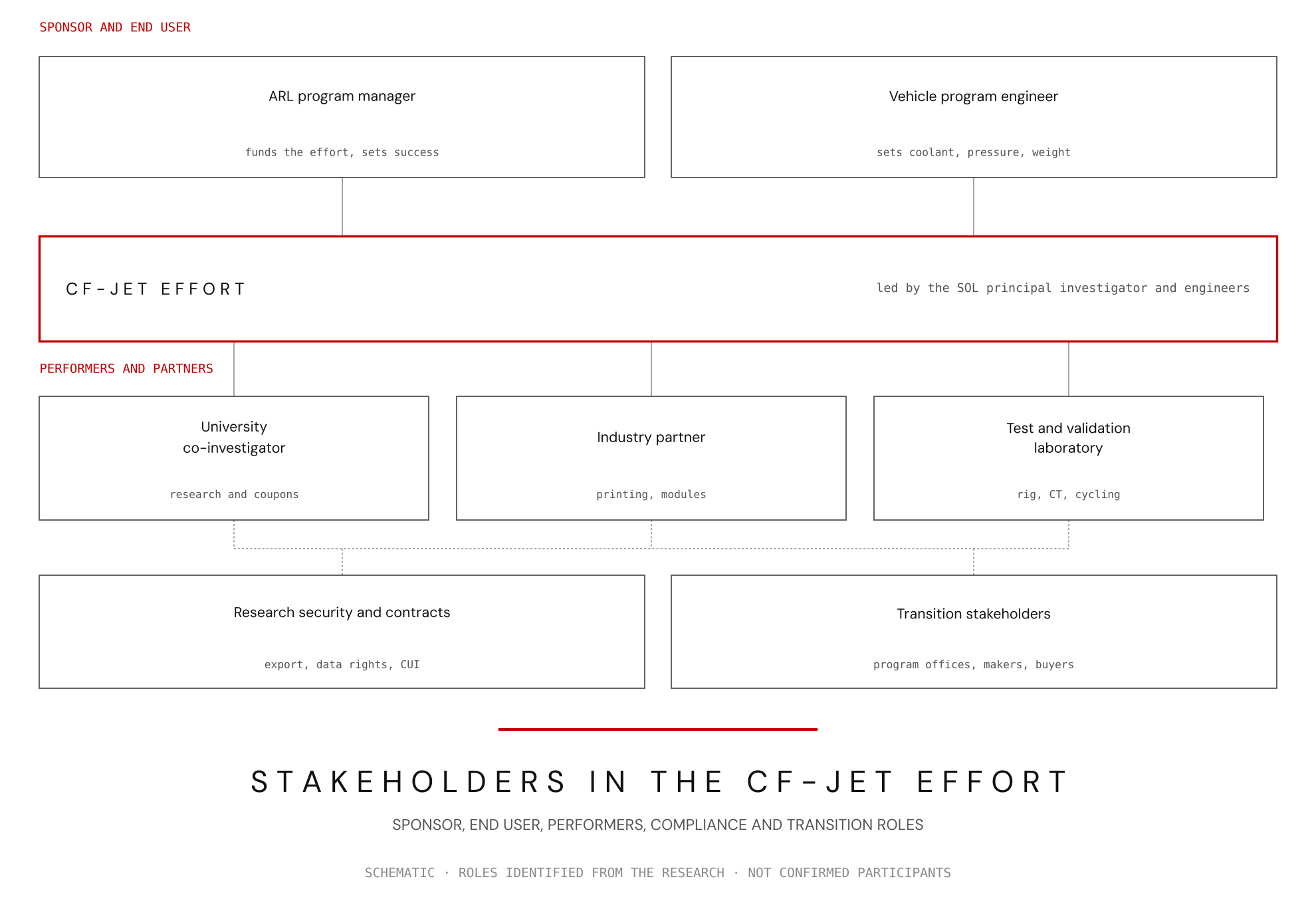
Schematic. Organizations are examples named in the research. Roles were identified from the research and are not confirmed participants.
Table 1. Stakeholder map
| Role | Organization examples | Stake | Primary decision | Evidence |
|---|---|---|---|---|
| ARL program manager | DEVCOM Army Research Laboratory; topic point of contact for ARL-BAA-0107 | Return on a funded research effort and milestones that can be tested | Whether to fund the effort and which results count as success | Solicitation ARL-BAA-0107; Army funding documents |
| Vehicle program engineer | DEVCOM Ground Vehicle Systems Center; Army vehicle program offices | A cooler that fits the vehicle coolant loop, weight and power budget | Whether the cooler meets thermal limits at the coolant the vehicle supplies | Public Army briefings and published studies |
| University co-investigator | HBCU and minority-serving institution faculty; Auburn University (CT); Alabama A&M, Tuskegee and Jackson State (printing and materials) | Research tasks, student training, publication and facility use | Which measurements the laboratory can commit to and publish | Capacity survey in the research; gaps stated |
| Research security and contracts staff | University sponsored-programs and research-security offices; SOL contracts and export-control staff | Compliance with export, data rights and CUI rules | Whether the work is fundamental research and whether CUI controls apply | Regulations and agency guidance; gaps stated |
| SOL principal investigator and engineers | SOL Engineering Services thermal and AI engineers | A defensible result at the design point | Which test comes first and how much margin the design includes | Peer-reviewed measurements and computed benchmarks |
| Industry partner | Additive manufacturing providers; power-module makers | Printable geometry, qualified modules and protected baselines | Whether to commit printing or module capacity to the effort | Peer-reviewed measurements; vendor claims unverified |
| Test and validation laboratory manager | University or contract facility with flow loop, laser flash, CT and thermal cycling capability | Measurements with a stated uncertainty | Which test definition, rig and acceptance limit to use | Standards and published rig studies; uncertainty computed |
| Transition stakeholders | Army program offices; vehicle and radar manufacturers; data center buyers; nonprofit intermediaries | A qualified product with a supply route | Whether to fund, qualify or buy a validated plate | Analyst estimates, trade reports and funding documents |
Organizations are examples cited in the research as holding capacity or authority. None has confirmed participation in the effort.
1.2 The validation sequence assigns owners
The research recommends sequencing tests by cost, so that cheap tests narrow what the costly tests must prove. Figure 2 arranges the recommended tests as four stages and names the role that leads each stage and the result that gates it. Table 2 lists the part each role plays in each stage. The assignment of roles is a proposal assembled from the recommendations in the research and has not been agreed with any organization.
Figure 2. Validation sequence with role owners
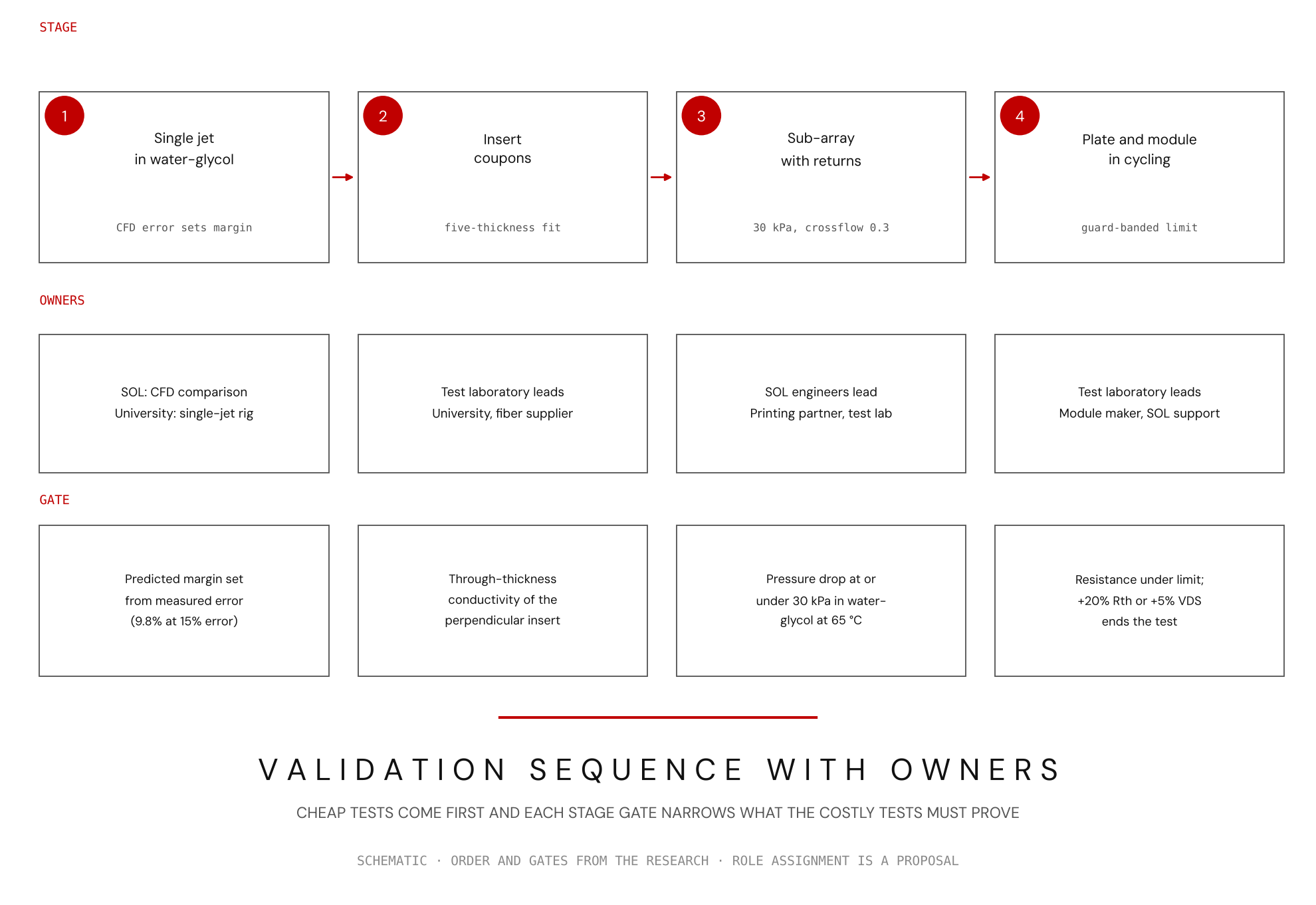
Schematic. Stage order and gates follow the recommendations in the research. Role assignments are a proposal.
Table 2. Role responsibilities by validation stage
| Role | Single jet | Insert coupons | Sub-array | Plate and module | Evidence |
|---|---|---|---|---|---|
| ARL program manager | Informed | Informed | Reviews | Reviews and accepts | Guard-banded acceptance limit in the testing and validation research |
| Vehicle program engineer | Informed | Informed | Supplies conditions | Reviews at 65 to 115 °C | Inlet temperatures of 65, 85, 105 and 115 °C in the Army electronics research |
| University co-investigator | Leads the rig | Supports | Informed | Supports | Single-jet rig as a teaching project; capacity survey |
| Research security and contracts staff | Reviews | Reviews | Reviews | Reviews | Export, data rights and CUI rules in the compliance research |
| SOL principal investigator and engineers | Leads the CFD comparison | Supports | Leads | Supports | Validate the simulation first; test a sub-array with returns |
| Industry partner | Informed | Supports | Supports | Supports | Build rules from the printing research; controlled module pairs |
| Test and validation laboratory manager | Supports | Leads | Supports | Leads | Test definition and uncertainty in the testing research |
| Transition stakeholders | Informed | Informed | Informed | Reviews results | Component-level budgets and qualification by a prime in the market research |
Assignments are proposed here from the recommendations in the research and are not agreed with any organization.
1.3 One design point serves every role
Every role works from the design point in Table 3. The values are assumptions of the proposal or values computed from them, and no Army document states them as requirements.
Table 3. CF-JET design point and what it means
| Quantity | Value | Meaning for the roles | Evidence |
|---|---|---|---|
| Heat load | 1.5 kW | Within the 2 to 12 kW that one conversion stage gives off | Design assumption of the proposal |
| Cooled area | 60 mm by 60 mm (36 cm²) | The footprint of one module position | Design assumption of the proposal |
| Average heat flux | 41.7 W/cm² | Die-level flux is 12 to 24 times this footprint value | Computed from 1,500 W over 36 cm² |
| Coolant | 50/50 water-glycol, 65 °C inlet | The current Army inlet temperature in public documents; the future range is 80 to 105 °C | Design assumption; Army range from public documents |
| Flow rate | 4 to 8 L/min | Sets a coolant rise of 3 to 6 K | Design assumption; rise from the testing research |
| Pressure drop | 30 kPa or less | Most of a 34.5 kPa loop budget that other components share | Design assumption; loop budget from Army documents |
| Thermal resistance | 0.02 K/W, or 72 mm²·K/W | The acceptance target | Computed from 0.02 K/W times 3,600 mm² |
| Temperature rise at full load | 30 K, giving a 95 °C case at a 65 °C inlet | Exceeds the 80 °C limit stated for radar transmit and receive modules | Computed from 1,500 W times 0.02 K/W |
1.4 Each role asks a different first question
Table 4 lists the question each role asks first, the number that answers it and the study in the research that holds the detail. The number is the figure a role should expect to see first in a briefing.
Table 4. First question and first number for each role
| Role | First question | Number that answers it | Evidence |
|---|---|---|---|
| ARL program manager | Is the target credible? | 72 mm²·K/W against 9 to 158 published and 100 to 200 for conventional plates | Limits of Conventional Liquid Cold Plates and Jet-Impingement Crossflow; interpretation of published data |
| Vehicle program engineer | Does it work at vehicle coolant temperatures? | A design validated at 65 °C loses 36 to 58 percent of module capacity at 105 °C | Thermal Management Demands of Silicon Carbide Power Electronics in Army Ground Vehicles; computed |
| University co-investigator | What can our laboratory measure? | No flow loop, laser flash or thermal cycling documented at an HBCU or community college | Test Infrastructure, Validation, and Quality Assurance for AM Thermal Hardware; gap stated |
| Research security and contracts staff | Which rules apply? | 110 CUI requirements; 20 years of SBIR data protection | Program, Teaming, Data Rights, and Compliance Considerations; regulations |
| SOL principal investigator and engineers | What error does the design include? | A 9.8 percent margin at a 15 percent model error | Engineering Design Under Sparse Data; computed |
| Industry partner | Can the plate be printed and qualified? | A horizontal 1 mm channel printed at 805 µm, which raises pressure drop 2.4 times | Additively Manufactured Jet-Impingement Cold Plates with Interleaved Returns; measured and computed |
| Test and validation laboratory manager | Can the rig verify 0.02 K/W? | ±10.6 percent reported on 0.0198 K/W | Test Infrastructure, Validation, and Quality Assurance for AM Thermal Hardware; reported |
| Transition stakeholders | How large is the market and who buys? | Estimates of $0.87 to $4.97 billion for 2024 | Markets, Transition Pathways, and Commercialization for Advanced Cold Plates; analyst estimates |
10. Where Each Role Finds Detail
Table 13 lists the research studies that hold the detail for each role. Each study contains the sources, the computed values and the stated gaps behind the numbers in this guide.
Table 13. Studies to read first, by role