
1 · The problem
The Defense Logistics Agency employs about 26,000 people worldwide across nine supply chain domains, and its 2025–2030 Strategic Plan names workforce readiness as one of four foundational pillars. The tools leaders have for judging workforce health, anticipating personnel risk and planning for surges are largely retrospective and disconnected from mission performance data. Static headcount dashboards and annual planning cycles cannot support the decision speed that great power competition demands.
SBIR Topic DLA26BZ03-NV011 names the gap: DLA seeks a dynamic workforce digital twin that generates synthetic data, enables scenario planning and speeds the adoption of AI-enabled workforce management.
2 · The concept
ALICE is a persistent, AI-powered simulation of the DLA organization. It models the organization as a dynamic system of interdependent roles, skills, relationships and workflows. A dashboard reports the current state; a digital twin simulates future states, showing which vacancies matter and what happens downstream when they persist. ALICE gives leaders three capabilities current tools do not:
3 · Architecture
Figure 1, the OV-1 operational concept, frames the system in three columns: the operational context and authoritative data that feed ALICE, the five-layer workforce intelligence architecture, and the decision support outputs for operational users. Governance guardrails run beneath all three: Privacy Act constraints, de-identification, differential privacy, RMF and CUI authorization, role-based access and data lineage.
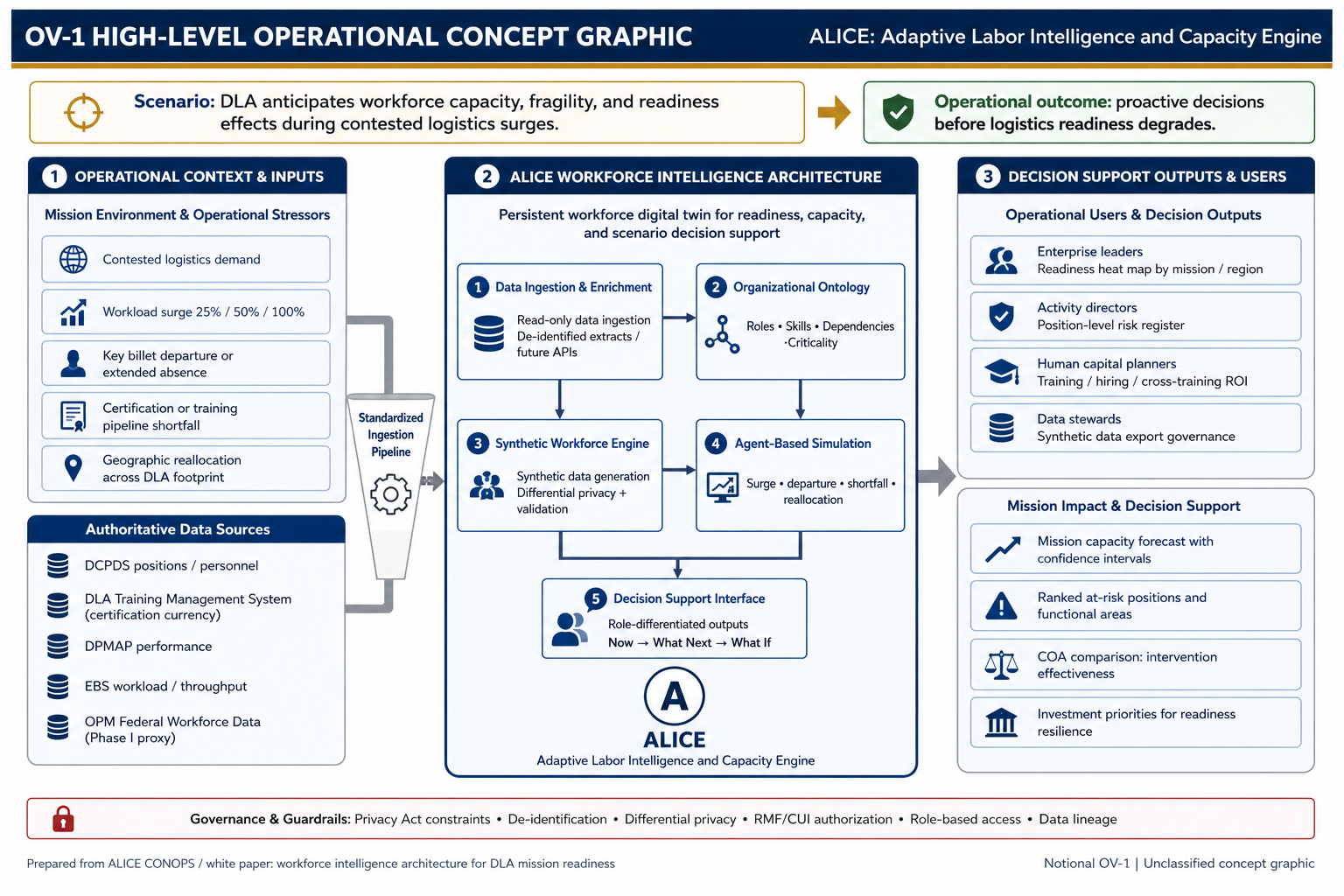
- 01Data ingestion and enrichmentRead-only ingestion of de-identified extracts from authoritative sources such as DCPDS, the DLA Training Management System, DPMAP and EBS, with OPM federal workforce data as a Phase I proxy.
- 02Organizational ontologyRoles, skills, dependencies and criticality modeled as a connected structure, the basis of the agent model.
- 03Synthetic workforce enginePrivacy-preserving synthetic workforce populations generated under differential privacy and validated against statistical targets.
- 04Agent-based simulationSimulates surges, key departures, certification shortfalls and geographic reallocation across the organization.
- 05Decision support interfaceRole-differentiated outputs that move from now, to what next, to what if: readiness heat maps, ranked at-risk positions and course-of-action comparison.
4 · Phase I plan
Phase I is a six-month feasibility program with four objectives, each producing a tangible deliverable and the evidence base for Phase II.
- MONTHS 1–2Kickoff, pilot sub-component selection, data use agreement, ontology construction and expert review
- MONTHS 3–4Synthetic data generator, agent model calibration and simulation prototype
- MONTH 5Historical backtesting, interface prototype and user evaluation sessions
- MONTH 6Final report, Phase II plan and deliverables
5 · Documents
The white paper sets out the case and the architecture. The Supporting Documentation Package records the research, decisions, components, data, interfaces, risks, requirement traceability and assumptions behind it; Artifacts 1–8 of its eleven are published here. All are drafts pending stakeholder gate review.