CF-JET: AI/ML-Enabled Design of a Carbon Fiber Jet-Impingement Cold Plate
Additively manufactured, liquid-cooled jet-impingement cold plate with an optimized carbon fiber target plate — and the re-usable AI framework used to design it.
“Remember that the AI revolution is about hardware development more than the software development that it enables.”
Cold plate design for liquid-cooled AI chips and power electronics is the topic. The journey to get there spans artificial intelligence, advanced manufacturing, innovative materials, thermal sciences, modeling and simulation, and experimental testing — carried out with a re-usable AI framework.
1 · The problem
Army ground vehicles are adding hybrid-electric drives, onboard power generation, silent watch and high-power electronics. Silicon carbide inverters concentrate heat in small areas, and every kilogram of cooling hardware competes with armor, payload and range. Today’s cold plates are machined or brazed aluminum and copper.
Weight
Copper is about 8.9 g/cm³ and aluminum about 2.7 g/cm³ — mass that competes with armor and range.
Performance ceiling
Finned and swaged-tube plates floor near 100–200 mm²·K/W (P3).
CTE mismatch
Copper and aluminum expand 4–6× more than SiC dies, driving thermal-cycle wear-out (P2).
2 · Design point
The target is aggressive against conventional cold plates and lies inside the range published jet and microchannel results have reached.
PARAMETER
CF-JET TARGET
SOURCE
Heat load
1.5 kW
Briefing
Footprint
60 × 60 mm
Briefing
Case-to-coolant resistance
0.02 K/W
Briefing
Area-normalized resistance
72 mm²·K/W
Derived, P3
vs finned cold plate
1.4× better
P3
vs swaged-tube cold plate
2.8× better
P3
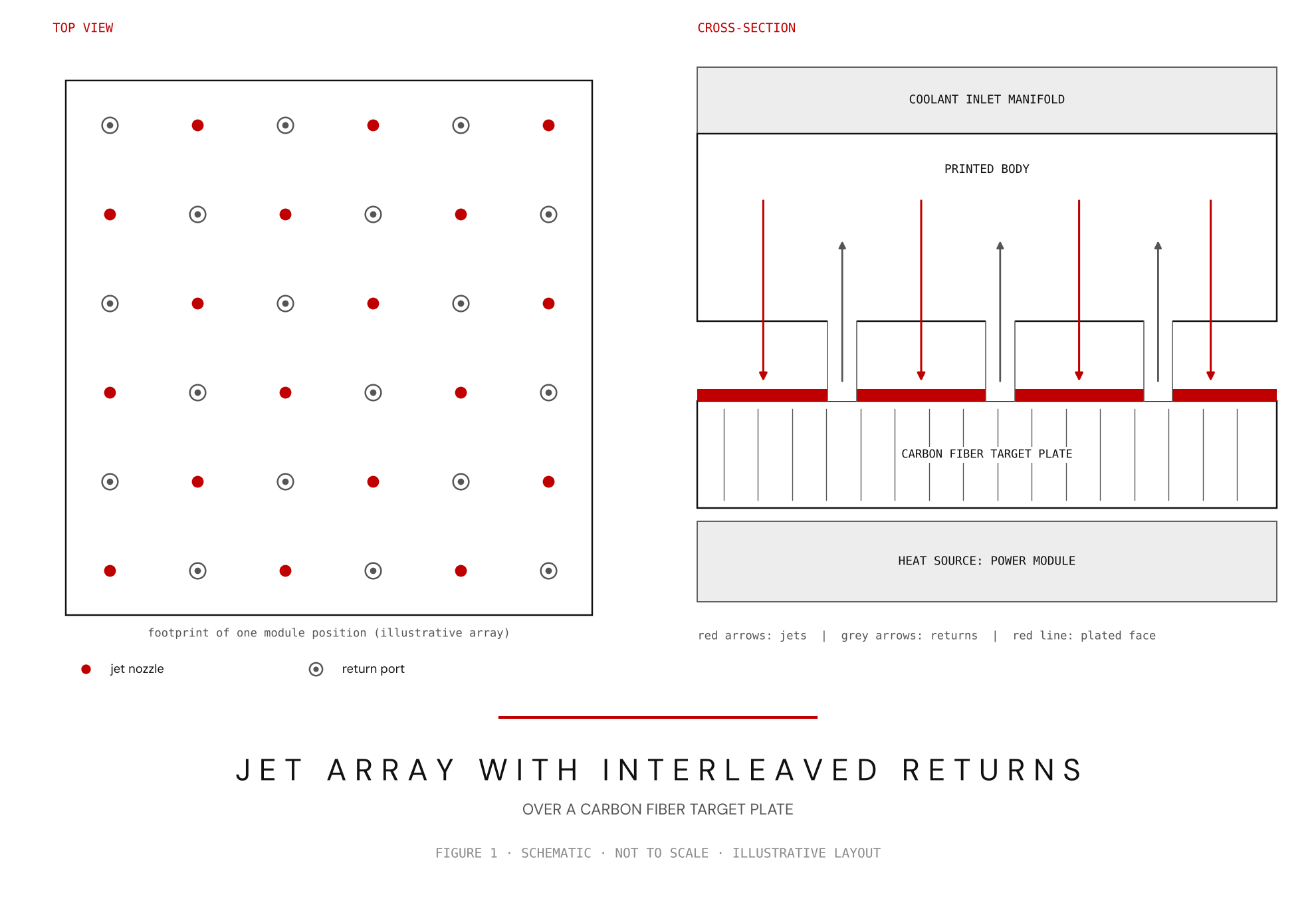
FIGURE 1 · Jet array with interleaved returns over a carbon fiber target plate. Schematic, not to scale; illustrative layout.
3 · Approach: Forest-to-Desert Framework™
Codified physics and expert rules reduce the need for data. Separating epistemic and aleatoric uncertainty decides when to trust learned models. A data flywheel improves both as real test data arrives. The framework, its seven-phase protocol and its wider research topics are set out in the Forest-to-Desert Framework briefing.
A
SOL Aquifer™
Codified physics and expert rules reduce the data a model needs.
B
Uncertainty-aware neuro-symbolic inference
Separates epistemic and aleatoric uncertainty to decide when to trust a model.
C
Data flywheel
Each test article improves the surrogate and the rules together.
SOL Aquifer™ training pipeline
01IngestionPull rows from SQLite into a DataFrame.
02PreprocessingScale and normalize features (StandardScaler).
03Train/test split5-fold cross-validation splits.
04Training loopForward pass, MSE loss, backprop, Adam weight updates.
05EvaluationRMSE on the hold-out fold.
4 · Supporting evidence
47%
P1 · Thermal Management Demands of Silicon Carbide Power Electronics in Army Ground Vehicles
A cold plate that dissipates 1,340 W per module with 25 °C coolant retains about 47 percent of that capacity at 105 °C coolant, the future Army engine-coolant temperature.
S2 · Carbon Fiber Composite Target Plates for High-Heat-Flux Cooling
Conducting 50 W/m·K through the plate needs continuous high-conductivity fiber standing perpendicular at roughly 6 to 9 percent by volume; no measurement of a millimeter-thick insert at that level was found.
S3 · Surrogate Modeling, Multi-Fidelity Learning, and Optimization for Thermal-Fluid Design
Published cooler surrogates reproduce CFD within 0.2 to 2 percent after 20 to 100 simulations, so the ±5 percent target lies inside the reported range for smooth, low-dimensional design spaces.
S4 · Uncertainty-Aware Neuro-Symbolic AI for Engineering Decisions
In a computed benchmark, a physics rule plus learned correction predicted outside its training region with 3.1 percent error, against 7.0 percent for a learned model and 15.7 percent for the rule alone.
S5 · Test Infrastructure, Validation, and Quality Assurance for AM Thermal Hardware
Instruments verify 0.02 K/W to about ±3.0 percent, yet the case-temperature definition and joining pressure shift the same quantity by 3.3 to 42.9 percent in published rigs.
X1 · Markets, Transition Pathways, and Commercialization for Advanced Cold Plates
Analyst estimates of the 2024 liquid-cooling market range from $0.87 billion to $4.97 billion because each counts something different; cold plates alone are near $0.3 billion.
X2 · Program, Teaming, Data Rights, and Compliance Considerations
A small business proposing to ARL with a university partner meets five sets of rules at once; the funding vehicle decides most of the terms, and several vehicles cannot pay a small business.
Alabama A&M University · University of South Florida
AM, MECHATRONICS & MACHINE SHOP
Drake State Community and Technical College
HOW TO CITE
Kolb, J. (2026, November 13). CF-JET: AI/ML-Enabled Design of an Additively Manufactured, Liquid-Cooled Jet-Impingement Cold Plate with Optimized Carbon Fiber Target Plate [Research briefing] (SOL-RP-2026-001). SOL Engineering Services, LLC. https://solresearchlabs.com/projects/cf-jet