
Executive Summary
A small business that proposes a cold plate and an AI design pipeline to the Army Research Laboratory (ARL), with a university partner, meets five sets of rules at once: solicitation requirements, funding vehicles that exclude industry, export control and fundamental research boundaries, data rights allocation, and cybersecurity obligations for controlled unclassified information (CUI). The retrieved texts show that the vehicle chosen decides most of the terms, and that several vehicles cannot pay a small business at all (Table 2).
The umbrella ARL announcement admits small businesses, requires no whitepaper and scores three criteria. Amendment 4 of W911NF-23-S-0001 encourages a whitepaper of five pages or fewer, asks the topic point of contact for a response, and names merit, Army mission contribution and investigator qualifications as core criteria (Table 1).1 ARL-BAA-0107 is described as academic work at 6.2 and 6.3 with hardware deliverables, so a small business prime needs the point of contact to confirm fit.2
The two HBCU and minority-serving institution vehicles that were retrieved fund institutions only. The 2026 pilot offers five grants totaling about $50 million, at most $10 million each, and bars subawards and equipment; the 2024 partnership offers $2.02 million per award over five years, and its collaborators must be degree-granting institutions (Table 2).34 The 2026 ceiling is 5.0 times the 2024 total (computed). A small business reaches these institutions by a different instrument: an STTR award, a subaward under a BAA, or a cooperative agreement with an ARL laboratory.
Nonprofit intermediaries hold some of the largest Army research vehicles in the retrieved records. One intermediary holds an ARL other transaction agreement with a potential value of $52.4 million, and a reliance framework cut one university agreement from more than six weeks to two days (Table 3).56 No retrieved source states the fees, intellectual property terms or eligibility of any intermediary for cold plate work.
Fundamental research status depends on the budget category and on whether the performer accepts publication limits. DoD guidance treats 6.1 research as fundamental whoever performs it and 6.2 research as fundamental when performed on a university campus, and ARL-BAA-0107 spans 6.2 and 6.3 (Table 4).78 Hardware is outside 15 C.F.R. § 734.8, and a university that accepts a sponsor's publication restriction loses the exclusion.9
SBIR and STTR data protection lasts 20 years from award, followed by Government purpose rights that do not expire. An STTR award needs an intellectual property agreement signed by both parties before award (Table 5, Figure 4).1011
No retrieved solicitation requires documentary proof that an offeror owns an algorithmic baseline. The mechanisms found require an offeror to list restricted data and software with a basis for each assertion, and the Government assumes no restrictions on anything not listed (Table 6).1213 Model weights trained on Government-funded data have no clear regulatory answer.14
CUI work on an on-premises AI cluster falls under 110 NIST SP 800-171 requirements whatever the status of CMMC. DFARS 252.204-7012 requires those controls and reporting within 72 hours, whether or not CMMC applies; Phase 2 was suspended on 13 July 2026 (Table 7, Figure 5).151617
1. Introduction and Scope
The CF-JET proposal describes a three-dimensional printed jet-impingement cold plate with interleaved return ports and a carbon fiber target plate with perpendicular pitch fiber inserts, sealed by a thin electroplated coolant face.18 The design point is 1.5 kW on a 60 mm by 60 mm footprint, with 50/50 water-glycol entering at 65 °C at 4 to 8 L/min, a pressure drop of 30 kPa or less and a thermal resistance of 0.02 K/W. Those values give a plate-average heat flux of 41.7 W/cm² and a coolant-to-case rise of 30 K at full load (computed). The effort responds to ARL-BAA-0107, draws on ARL-BAA-0038 and uses elements of ARL-BAA-0064.19
Figure 1. Teaming routes, agreement vehicles and compliance gates around the CF-JET effort
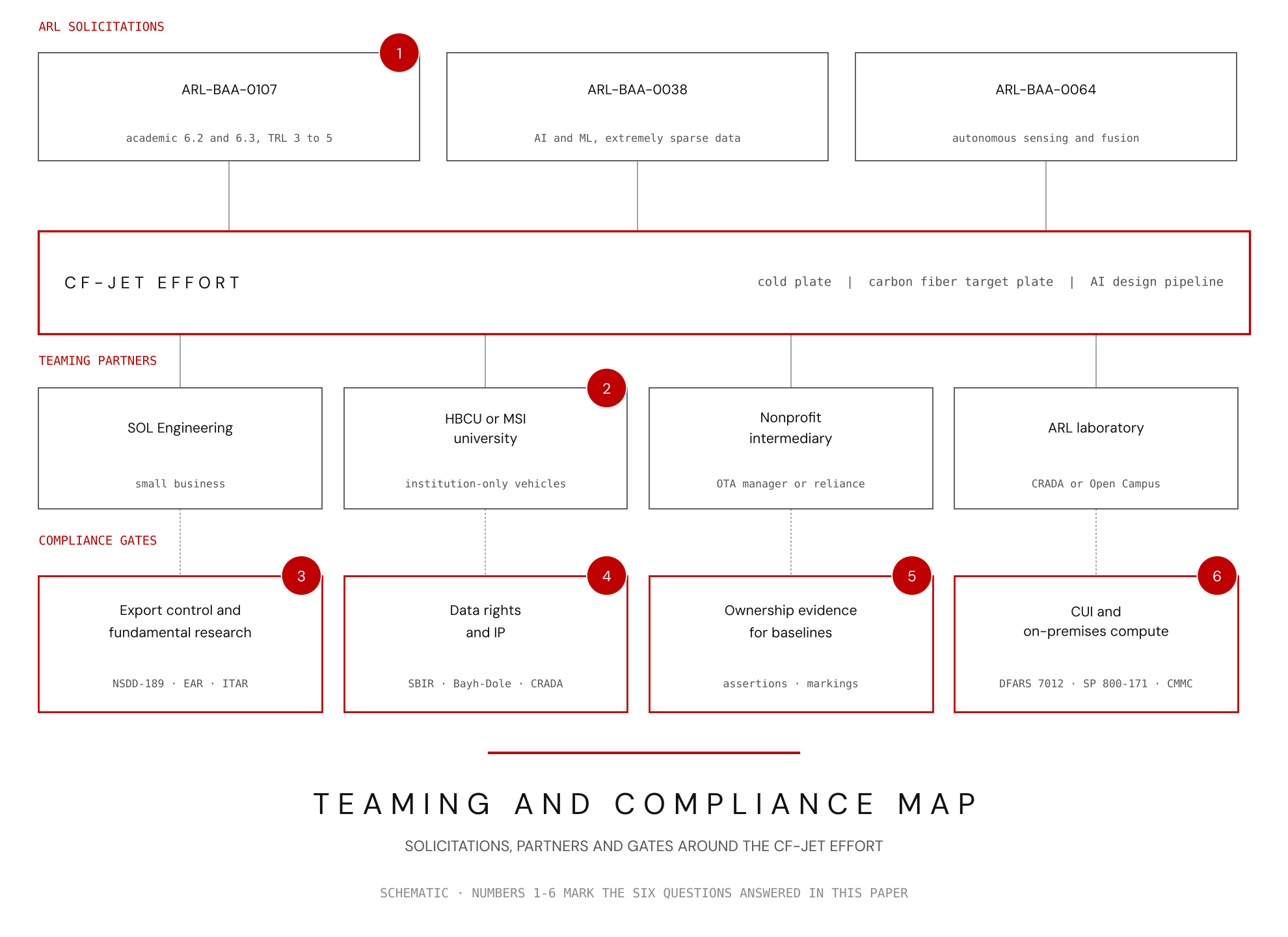
Schematic. Boxes show the routes and gates reviewed in this paper; amounts are those stated by the sources cited with Tables 2 and 3. Markers 1 to 6 locate the six questions answered here.
SOL Engineering Services describes a software pipeline, SOL Aquifer, that codifies engineering steps as code: scripted condition sweeps, physics solvers in code, a SQL database that records provenance, and surrogate training with uncertainty quantification.20 The same documents describe a data flywheel that recalibrates the surrogates from coupon, single-jet and prototype data. SOL Aquifer originated in HVAC modeling work done with Alabama A&M University students.21 These capabilities are SOL's proposed or demonstrated, and the algorithmic baselines in them are the assets whose ownership and protection this paper examines.
Figure 1 maps six questions. The first asks what the current ARL-BAA-0107, ARL-BAA-0038 and ARL-BAA-0064 texts require for submissions, white papers, eligibility and evaluation. The second asks which Department of Defense programs for historically Black colleges and universities (HBCUs) and other minority-serving institutions (MSIs) fund this effort. The third asks how National Security Decision Directive 189 (NSDD-189) and the International Traffic in Arms Regulations (ITAR) and Export Administration Regulations (EAR) apply to cold plate and AI design research at universities. The fourth asks what data rights and intellectual property terms small businesses and universities typically agree under ARL agreements. The fifth asks which solicitations require proof of ownership of algorithmic baselines. The sixth asks what the Cybersecurity Maturity Model Certification (CMMC) and NIST SP 800-171 require for on-premises AI compute that processes CUI.
The scope also covers nonprofit intermediaries as agreement vehicles. Where a retrieved source is silent on a term, the paper states the gap with the finding, and values are marked as computed where this paper calculated them.
2. Solicitation Requirements for ARL-BAA-0107, ARL-BAA-0038 and ARL-BAA-0064
2.1 The three topic identifiers belong to one umbrella announcement, and the umbrella announcement sets the submission rules
ARL describes its broad agency announcement as the primary mechanism for assistance agreements, usable also for contracts and other transactions, and it encourages applicants to contact the topic point of contact before submitting.22 The announcement in force, W911NF-23-S-0001 as amended on 8 January 2025, is issued under FAR 6.102(d)(2) for the competitive selection of basic and applied research proposals.23 The topic identifiers ARL-BAA-0038 and ARL-BAA-0064 appear as entries in the December 2024 topic list for that announcement, each with an ARL office, a point of contact, disciplines and a description.2425 No stand-alone solicitation text for any of the three identifiers was found, so the submission and evaluation rules in Table 1 are those of the umbrella announcement.
Table 1. ARL solicitation requirements by announcement and topic
| Announcement or topic | Scope | Eligible applicants | Submission steps | Evaluation criteria | Evidence type |
|---|---|---|---|---|---|
| ARL BAA W911NF-23-S-0001 (umbrella announcement, Amendment 4) | Basic and applied research; ARD funds mainly 6.1 and 6.2, ARO mainly 6.1; 6.3 and 6.4 when they help the mission | Institutions of higher education, nonprofits, state and local governments, foreign organizations, large and small businesses | Whitepaper of five pages or fewer is encouraged and is not required; the topic point of contact answers “encouraged” or “not encouraged”; proposal on SF 424 (R&R) or ARO Form 51 with a one-page abstract, three-page biographical sketches and a two-page data management plan | Scientific and technical merit; contribution to the Army mission; qualifications of the principal investigator and key personnel | Government solicitation26 |
| ARL-BAA-0107, Academic Applied and Advanced Innovation | Applied (6.2) and advanced technology development (6.3); hardware, software or knowledge products at TRL 3, 4, 5 (retrieved text ends there) | Research conducted through academic institutions and academic-affiliated research institutes or centers | Not retrieved; the umbrella announcement governs, and the topic point of contact is the first step | Not retrieved; the umbrella criteria are the only stated ones | Government portal text, partial27 |
| ARL-BAA-0038, AI and ML with Extremely Sparse Data | ARD topic in data sciences and informatics under military information sciences; learning from limited data with expert rules, uncertainty-aware neuro-symbolic methods, edge processing and graph neural networks | Not stated in the topic text | Not stated in the topic text | Not stated in the topic text | Government topic list28 |
| ARL-BAA-0064, Autonomous Sensing and Information Fusion for Advanced Indications and Warnings | ARD topic in computer science, data sciences and network science; sensing, fusion across unattended ground sensors and small autonomous platforms; Future Vertical Lift priority | Not stated in the topic text | Not stated in the topic text | Not stated in the topic text | Government topic list29 |
Rows for ARL-BAA-0038 and ARL-BAA-0064 repeat the topic-list fields; the December 2024 list does not state audience, research type or award type, and ARL-BAA-0107 does not appear in that list. The ARL-BAA-0107 row rests on search-result text from the ARL portal, which did not render when fetched. Interpretation: the umbrella announcement rules apply to all three topics unless a topic states otherwise.
2.2 The announcement scores merit, Army contribution and investigator qualifications, and it requires no cost sharing
The announcement states no prescribed whitepaper format. A whitepaper should not exceed five pages and should give the title, submitter, topic name and identifier and the point of contact; the point of contact replies that the submitter is encouraged or not encouraged to propose, and a whitepaper is not required before a proposal.30 A full proposal includes a cover page on SF 424 (R&R) or ARO Form 51, a project abstract of one page or less, biographical sketches of three pages per investigator, a bibliography, current and pending support, facilities and equipment, a budget on ARO Form 99, a data management plan of no more than two pages and Privacy Act consent forms.31 The retrieved text does not state a page limit for the project description.
Core evaluation criteria for most award types are scientific and technical merit, potential contribution to the Army mission, and qualifications of the principal investigator and key personnel.32 Only one part of the announcement states an order of importance, so the criteria cannot be ranked from the retrieved text. Cost sharing is generally not required and is not an evaluation factor; cost proposals follow 2 C.F.R. Part 200 for universities and nonprofits and FAR Part 31 with DFARS Part 231 for for-profit organizations.33 The fiscal year 2021 National Defense Authorization Act also requires a proposal to disclose current and pending support.34 The Army Research Risk Assessment appears in the 2024 HBCU and MSI announcement as a step for selected proposals, and it does not appear in the retrieved part of the umbrella announcement.35
2.3 ARL-BAA-0107 targets academic work at 6.2 and 6.3, so a small business prime needs written confirmation of fit
The portal entry for ARL-BAA-0107, Academic Applied and Advanced Innovation, focuses on emerging and novel research by academic performers, including affiliated research institutes and centers.36 It covers applied research at budget activity 6.2 and advanced technology development at 6.3, with hardware, software or knowledge products supporting technology readiness levels 3, 4 and 5; the retrieved text is cut off after level 5.37 The umbrella announcement lists for-profit organizations among eligible applicants, and the topic entry describes academic performers, so the two texts leave open whether a small business may serve as prime under this topic.3839 A university prime with SOL as a subawardee is consistent with the topic text, and a SOL prime with a university subaward is consistent with the umbrella announcement. The point of contact can settle the question in the preliminary inquiry that ARL encourages.
The 6.2 and 6.3 categories matter beyond eligibility. ARL describes the Army Research Directorate as funding mainly 6.1 and 6.2 and the Army Research Office as funding mainly 6.1, with 6.3 and 6.4 when they help the mission.40 A CF-JET effort that builds and tests printed hardware is advanced technology development in part, and Table 4 shows that the fundamental research definition in DoD guidance reaches 6.1 and on-campus 6.2 work.41
2.4 ARL-BAA-0038 and ARL-BAA-0064 describe AI and sensing research, and only the first matches the CF-JET design pipeline in the retrieved text
ARL-BAA-0038 seeks ways for Army systems to learn and predict when training data is very limited, and it proposes combining data-driven learning with expert-defined rules and uncertainty-aware methods in neuro-symbolic architectures.42 Its goals include theory for learning from limited data, efficient approximations, deciding when simpler models suffice, edge processing and distributed learning with graph neural networks.43 That description matches the neuro-symbolic and uncertainty-aware elements that SOL attaches to its pipeline, and cold plate coupon, single-jet and prototype data are sparse by the standard of image or text corpora.44
ARL-BAA-0064 develops sensing technologies to detect and track military-relevant targets by fusing data from unattended ground sensors and relocatable small autonomous ground and air platforms, with physics research on low-power persistent sensing; its listed modernization priority is Future Vertical Lift.45 The retrieved description does not mention thermal management or cooling. The elements of this topic that the CF-JET proposal uses are therefore for SOL to state in its whitepaper, and the retrieved material gives no basis for naming them.
3. Academic Partnering with HBCUs and Minority-Serving Institutions
3.1 The two retrieved ARL HBCU and MSI vehicles fund institutions, and neither pays a small business
The DoD programs that apply here rest on 10 U.S.C. § 4144, which the 2024 OSD and ARL announcement cites as the basis for inviting applications from covered educational institutions.46 Table 2 sets the retrieved vehicles side by side. The 2024 ARL HBCU/MI Research Partnerships announcement funds up to five cooperative agreements of $2.02 million each over five years, tied to seven named ARL programs, and each whitepaper must address one of them.47 Its collaborators must be degree-granting institutions, they may hold at most half the budget, and collaboration with other entities is not permitted.48 The 2026 Pilot Program announcement is open only to covered educational institutions that are not R1, requires a senior institutional leader as principal investigator, and prohibits subawards and payments to non-institution collaborators.49
Table 2. DoD and Army vehicles that reach HBCUs and MSIs, with the role open to a small business
| Vehicle | Eligible applicants | Award size and duration | Industry role and limits | Evidence type |
|---|---|---|---|---|
| ARL HBCU/MI Research Partnerships, W911NF-24-S-0002 | Institutions meeting the covered educational institution definition under 10 U.S.C. § 4144 | Five cooperative agreements of $2.02 million each over five years; funding of $350 thousand, $350 thousand, $440 thousand, $530 thousand and $350 thousand by year | Collaborators limited to degree-granting institutions of higher education, with a ceiling of 50 percent of the budget; other entities not permitted | Government solicitation50 |
| Pilot Program to Increase Research Capacity, W911NF-26-S-0075 | Covered educational institutions; R1 institutions excluded; one application per institution; senior institutional leader as principal investigator | Five grants totaling about $50 million; $10 million ceiling per award; $2 million ceiling per year; up to five years | No industry partnership required; subawards, paid collaborators and payments to non-institution collaborators not allowed; equipment and consultant services not funded | Government solicitation51 |
| OSD and ARL HBCU/MI funding opportunity, W911NF-24-S-0009 | Covered educational institutions under 10 U.S.C. § 4144 | Not retrieved | Not retrieved | Government solicitation, introductory text only52 |
| ARO Trusted Partner Program | Universities and associated entities, nonprofit research institutes and federally funded research and development centers | Multiple-award contract; five-year agreements with a possible five-year extension; no dollar amounts stated | Sensitive work at CUI, Secret and Top Secret levels; pre-vetted partner list showing security tiers | Government news article53 |
| Army STTR within the Army SBIR/STTR Program | Small business with a research institution partner | Phase II guideline of $2.24 million under the SBA guidelines effective 16 October 2026 | Research institution performs at least 30 percent of the work; the principal investigator is employed by the small business or the primary research institution | Government page and law firm bulletin5455 |
Amounts are as stated in the solicitation summaries retrieved. The 2024 partnership numbers use the stated yearly profile; the pilot ceilings are $10 million per award and $2 million per year. The ARL-24-S-0009 row rests on introductory text only. Interpretation: where a vehicle bars industry collaborators, a small business can join only through a separate instrument.
Figure 2. Award size reference points in the vehicles reviewed
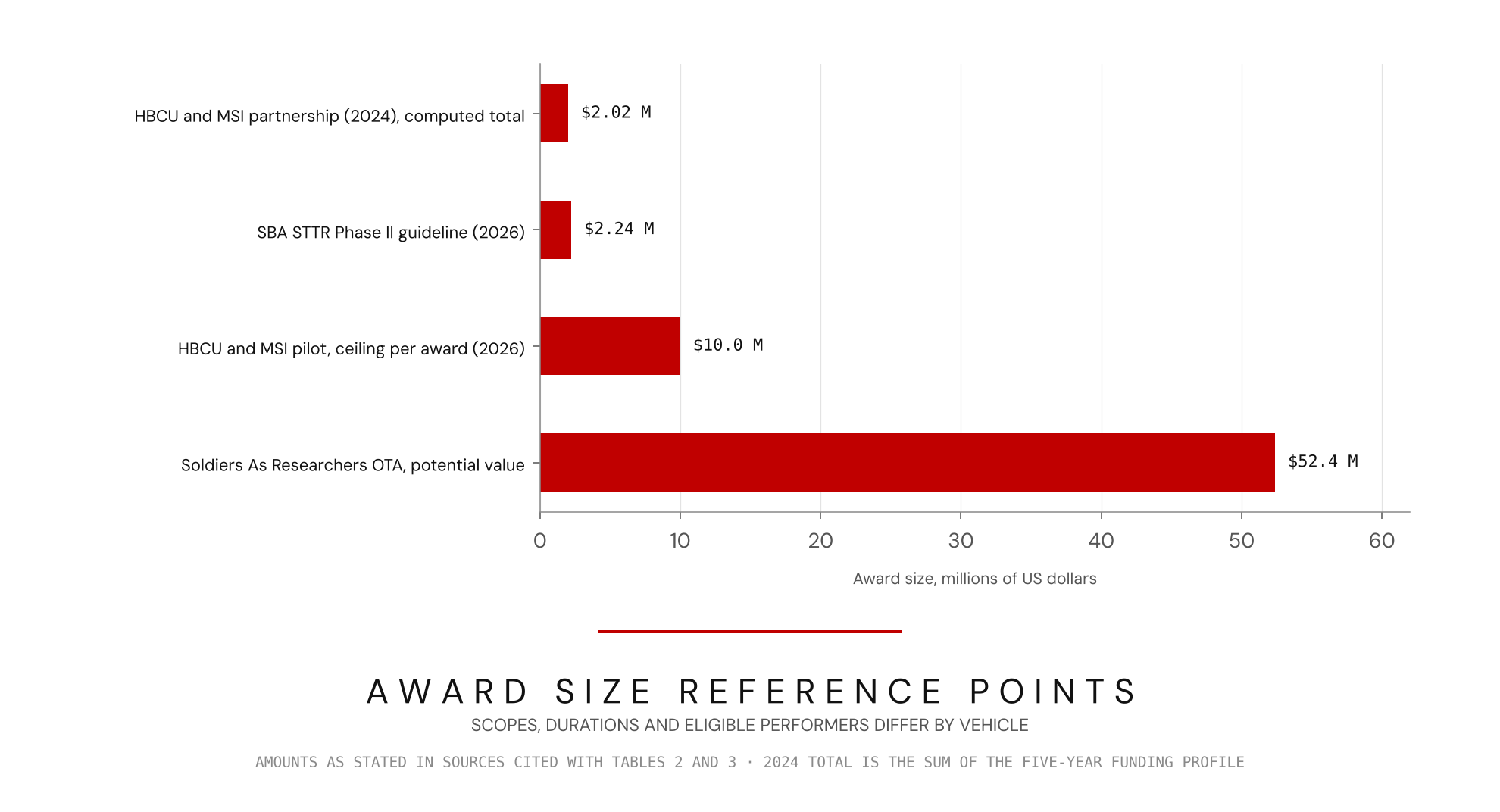
Drawn from Table 2 and Table 3. Values: HBCU and MSI partnership, $2.02 million over five years (computed from the yearly profile); SBA Phase II guideline, $2.24 million; HBCU and MSI pilot, $10 million ceiling per award; Soldiers As Researchers agreement, potential value $52.4 million. Scopes differ.
The pilot's ceiling of $10 million per award is 5.0 times the $2.02 million total of a 2024 partnership award (computed), and the five pilot grants average $10 million (computed from $50 million over five awards).5657 Figure 2 places both beside the SBA Phase II guideline of $2.24 million and the larger vehicles of Table 3.58
3.2 The pilot expects fundamental research, funds no equipment and requires United States citizens in key roles
The 2026 pilot states that the Government expects the work to be fundamental research and anticipates no publication restrictions; a non-fundamental proposal may be considered but may need modification or restrictions.59 Equipment, facility renovation, consultant services, tuition and fees, travel outside the contiguous United States and subawards are not funded, and the principal investigator and key personnel must be United States citizens.60 The announcement refers applicants to the DoW research and development general terms and conditions for export control and CUI obligations and does not address them itself.61 A cold plate prototype program needs fabrication and test equipment, so the pilot can fund the modeling and AI portions of a university's work and cannot fund hardware.
The pilot's timing limits its use for CF-JET. Applications were due on 10 April 2026, and awards were expected in late August 2026, so the retrieved announcement describes a window that has closed.62 The retrieved sources do not state whether ARL will issue another round, and the university relationship that CF-JET needs would use an STTR or a BAA subaward in the interim. A university that holds a pilot award can still collaborate with SOL on research that the pilot funds, and any exchange of data or software then needs a written agreement that states what each party contributes.
The seven criteria have equal weight: scientific and technical merit, relevance to critical technology or ARL areas, potential to build research capability, potential to raise the institution's Carnegie status, potential to strengthen STEM research and education, principal investigator qualifications and cost realism.63 Industry partnership is not an evaluation item, and cross-institution collaborations are tracked as a reporting metric.64 A university that applies for the pilot therefore competes on institutional capacity, and a SOL relationship adds value only as a research collaboration that the university conducts at no payment to SOL.
3.3 A small business teams with an HBCU or MSI through STTR, a BAA subaward or a cooperative research and development agreement
The Army SBIR/STTR Program lists four routes for an academic with a small business partner: a broad agency announcement, STTR, other transaction authority and the ARL Open Campus.65 STTR allows a small business to partner with more than one research institution so long as one institution performs at least 30 percent of the work and the principal investigator is employed by the small business or the primary research institution.66 The SBA Phase II guideline is $2.24 million under the guidelines effective 16 October 2026.67 SOL's HVAC work with Alabama A&M University students shows an existing relationship with an HBCU that could anchor an STTR research institution role.68
ARL also issued a request for information on university partnership models, DEVCOM-ARL-RFI-25-01, whose listing was updated on 13 May 2026; the retrieved listing does not give its content, and the responses may change future terms.69 Because the HBCU and MSI vehicles exclude industry payments, an effort that wants both an HBCU partner and SOL funding needs two instruments: an institution award that funds the university's capacity and an STTR, BAA subaward or agreement that funds the joint CF-JET work.
4. Nonprofit Intermediaries and Agreement Vehicles
4.1 Intermediaries hold large Army vehicles and shorten agreement timelines, and no retrieved source states their terms for hardware work
Table 3 lists the intermediary and agreement structures that the retrieved sources document. The Civil-Military Innovation Institute is described as a nonprofit organization, it holds the Soldiers As Researchers agreement, an ARL other transaction valued at up to $52.4 million, and it co-manages the Catalyst Pathfinder program with ARL.707172 A Pathfinder project with East Carolina University began in 2023 with roughly $1 million from ARL and became an Army Reserve agreement in August 2026, which shows a route from a university research project to an operational user.73 The retrieved records do not state the fees, intellectual property terms or small business eligibility of these agreements, and the one agreement structure retrieved in full text is for a biodefense consortium.74
Table 3. Intermediary and agreement structures documented in the retrieved sources
| Structure | Type | Documented role and size | Evidence type |
|---|---|---|---|
| Civil-Military Innovation Institute | Nonprofit organization in Morgantown, West Virginia | Holds an Army Research Laboratory other transaction agreement, Soldiers As Researchers, with a potential value of $52.4 million; co-manages the Catalyst Pathfinder program with ARL | Government award record via an aggregator; trade news7576 |
| Catalyst Pathfinder program | ARL program managed with the Civil-Military Innovation Institute | Funded a 2023 research project with East Carolina University at about $1 million that became an Army Reserve agreement in August 2026 | Government news article77 |
| Consortium managed firm in a consortium other transaction | Nonprofit or commercial manager contracting for a consortium of members | the New Jersey office of Army Contracting Command awarded a prototype other transaction to the Medical CBRN Defense Consortium through its managing firm, Advanced Technology International | Government agreement posted by another agency78 |
| SMART IRB reliance framework | National public-private initiative with about 5,000 member institutions | ARL joined in April 2026; a university agreement that remained under review after six weeks was processed within two days once routed through the framework | Government news article79 |
| Cooperative research and development agreement and Open Campus | Statutory agreement between an ARL laboratory and an industrial, nonprofit or university partner | ARL entered a CRADA with Greystones Group in March 2026; ARL’s Open Campus counted CRADAs for fiscal years 2013 and 2014 | Statute; government news articles808182 |
Amounts and dates are as stated in the cited records. The SMART IRB entry concerns human-subjects review and is included as an example of an intermediary reliance framework, and it has no direct bearing on cold plate research. Interpretation: documented timeline gains relate to review and reliance steps and do not extend to fundable scope.
Consortium other transactions add a manager between the Government and the performers. In the Medical CBRN Defense Consortium agreement, the Army contracts with the consortium through its managing firm, Advanced Technology International.83 The BAA lists other transactions for research and for prototypes among its instruments, and for research other transactions the intellectual property terms can be negotiated for expanded protection.84 Terms for members of a manager-led consortium are set in the consortium's own articles, so SOL would need those articles before committing a baseline to an intermediary-managed project.
An intermediary adds a party whose terms SOL must read before it signs. Five questions decide whether an intermediary fits the CF-JET effort: whether the agreement admits a small business as a performer or only as a member, whether the manager charges a fee on each award and at what rate, who holds title to inventions and data made under the agreement, whether members may keep background software proprietary, and what publication review the manager or the Government applies. The retrieved records answer none of the five for any intermediary in Table 3. The answers decide whether an intermediary vehicle shortens the path to the ARL program office or adds a layer to it.
Two further structures have timing and rights terms that the retrieved sources do state. A cooperative research and development agreement lets an ARL laboratory work with industrial organizations and nonprofit organizations including universities, and a collaborating party holding an exclusive license has the right of enforcement.85 ARL entered such an agreement with Greystones Group in March 2026 for AI research.86 The SMART IRB case shows what an intermediary framework can do for timing: routed through the framework, an agreement that had been in review for more than six weeks cleared within two days, although the case concerns human-subjects reliance and says nothing about hardware or software agreements.87
5. Export Control and Fundamental Research at Universities
5.1 DoD guidance treats 6.1 research as fundamental at any performer and 6.2 research as fundamental on campus
National Security Decision Directive 189 (NSDD-189) established that the products of fundamental research stay unrestricted to the extent possible, and DoD applies it through guidance that defines contracted fundamental research by budget category.88 Under that guidance, basic research at budget activity 6.1 is fundamental research whichever organization performs it, and applied research at 6.2 is fundamental research when it is performed on a university campus.8990 The operative memorandum is dated 24 May 2010, and it replaced a 2008 memorandum that used older category names.9192 Advanced technology development at 6.3 falls outside the categories that the guidance treats as fundamental, and for that work the contract terms decide publication and access.93 Table 4 sets the categories and the related export control texts side by side.
Table 4. Fundamental research treatment by budget category and export control text
| Category or case | Performer | Treatment | Basis | Evidence type |
|---|---|---|---|---|
| 6.1 basic research | Any performer, on or off campus | Contracted fundamental research; the results are ordinarily published and shared broadly | DoD guidance memorandum under NSDD-18994 | Government memorandum |
| 6.2 applied research | University campus | Contracted fundamental research when performed on campus; the retrieved passage states no other 6.2 case | DoD guidance, completed from the Harvard-hosted copy95 | Government guidance and memorandum |
| 6.3 advanced technology development | Any performer | Outside the contracted fundamental research categories; export control and publication terms apply by contract | DoD guidance memorandum96 | Government memorandum |
| Physical items such as a printed cold plate | Any performer | Outside 15 C.F.R. § 734.8, which covers technology and software that arise during or result from fundamental research | EAR text and a university compliance office page9798 | Regulation; university guidance |
| University research with sponsor publication limits | University | Loses fundamental research status when the university accepts restrictions on publication or on access | University compliance office page99 | University guidance |
| Information published through university fundamental research | Accredited United States university | Public domain under the ITAR when ordinarily published and shared broadly in the scientific community | Regulation text reproduced by a university100101 | Regulation; university guidance |
Treatment statements restate the cited passages. The 6.2 row records only the on-campus case, because the retrieved guidance passage ends in that sentence and the Harvard-hosted memorandum copy completes it. Interpretation: the CF-JET budget categories follow from the solicitation, and ARL-BAA-0107 spans 6.2 and 6.3, so a split between campus work and SOL-site work follows the category line.
ARL-BAA-0107 covers 6.2 and 6.3, so a CF-JET award can contain both fundamental and non-fundamental work.102 A university performing the 6.2 modeling and AI portions on campus can conduct that work as fundamental research. SOL-site fabrication and test of printed hardware is 6.3 work by the line that the guidance draws, and the contract can then impose publication review, access limits or other terms.103 A proposal that separates the two work packages by category and by performer location gives the contracting officer a basis to apply the right terms to each.
5.2 The EAR exclusion covers technology and software, so a printed cold plate stays subject to export rules
The rule at 15 C.F.R. § 734.8 of the Export Administration Regulations (EAR) provides that technology or software that arises during or results from fundamental research and is intended to be published is not subject to the EAR.104 The text covers information and code. It does not cover a physical item, and a university compliance office page states the same limit in plain terms.105 A printed cold plate, a carbon fiber target plate and an electroplated coolant face are physical items, so the exclusion cannot apply to them, and the export status of each depends on its own classification.
The AI portion of CF-JET produces software and technology: surrogate models, scripts and design data. Output of university fundamental research that is intended for publication falls within the exclusion.106 Proprietary SOL software that SOL keeps unpublished is not an output of fundamental research, so 15 C.F.R. § 734.8 does not exclude it, and whether the EAR applies to it depends on a classification that no retrieved source gives.
No retrieved source classifies a cold plate under an Export Control Classification Number or a United States Munitions List category. The classification of a cooling component can depend on the system it serves, and the retrieved sources do not address that question. An offeror that needs a definite answer can ask the State Department for a commodity jurisdiction determination or ask the Commerce Department for a classification, and no retrieved source covers either process.
5.3 The ITAR public domain provision protects published university research, and publication terms decide the outcome
The International Traffic in Arms Regulations (ITAR) exclude information in the public domain from the definition of technical data, and the public domain definition includes information published through fundamental research at accredited institutions of higher learning in the United States where the results are ordinarily published and shared broadly in the scientific community.107108 Both provisions turn on the same condition. A university that accepts a sponsor's publication restriction or access limit gives up fundamental research status, and the technology and software it produces then fall under the same rules as any other performer's work.109
SOL's baselines add a second route to that outcome. SOL Aquifer, its condition sweeps and its surrogate models are SOL's proposed or demonstrated capabilities, and SOL may wish to keep them proprietary.110 A university that accepts SOL's proprietary software for a fundamental research project can face a conflict if SOL requires approval before publication of results that disclose the baselines. The conflict is one of contract drafting, and a university research office will treat a publication restriction as grounds to move the project out of fundamental research. Figure 3 traces the decision for each budget category.
Figure 3. Fundamental research decision flow for university work under a CF-JET award
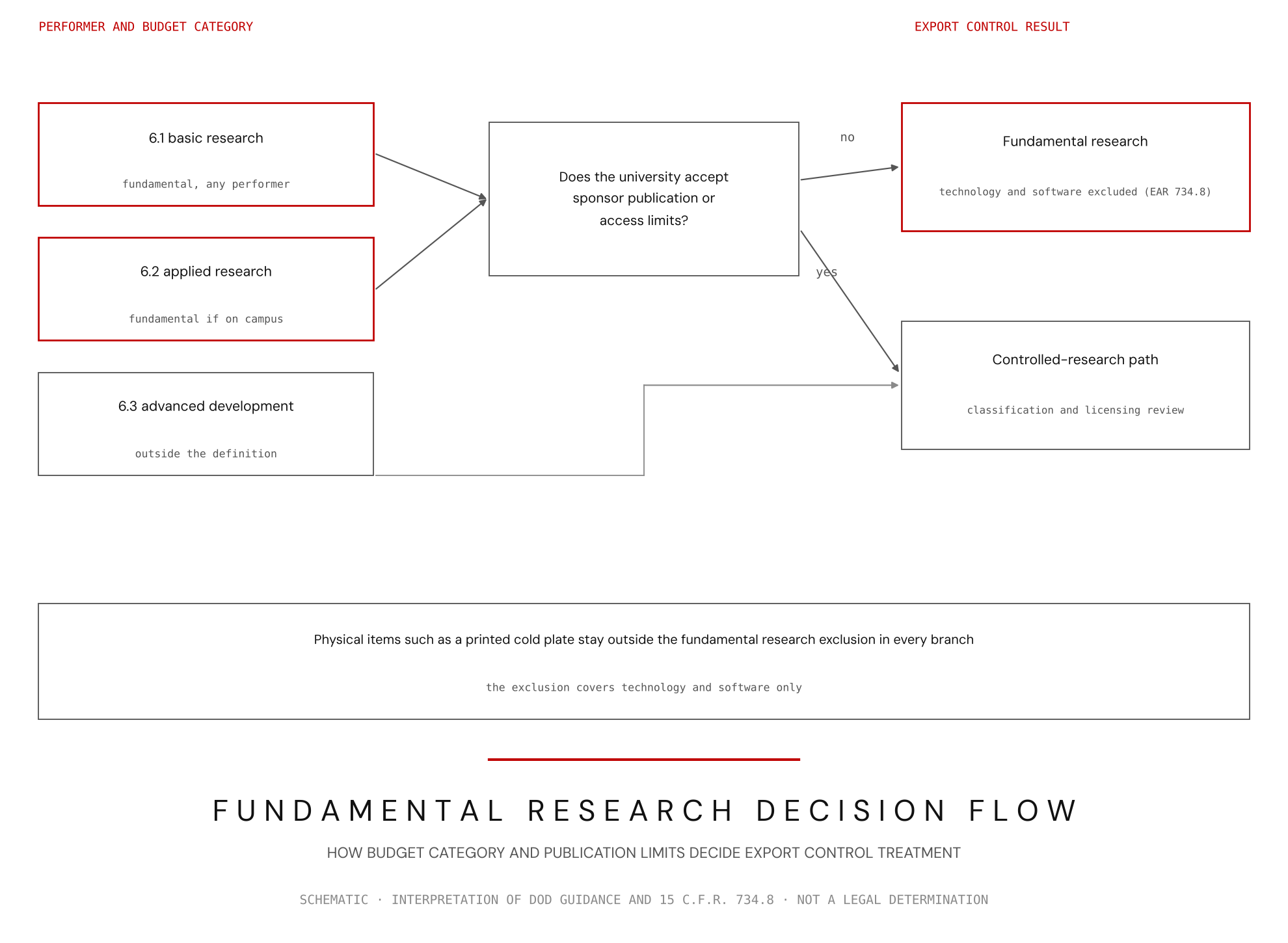
Schematic interpretation of the DoD guidance and 15 C.F.R. § 734.8 cited with Table 4. It is not a legal determination, and the guidance leaves some 6.2 cases to contract terms.
The 2026 pilot announcement illustrates the expectation on the university side. It anticipates no publication restrictions, it allows a non-fundamental proposal only with modification or restrictions, and it refers applicants to general terms and conditions for export control and CUI obligations.111 The ARO Trusted Partner Program addresses the opposite case: it pre-vets universities and associated entities for sensitive work at CUI, Secret and Top Secret levels, and its news article states neither publication terms nor export control terms.112 A CF-JET effort that needs CUI-level university work would use that kind of arrangement, and one that needs open publication would use fundamental research terms.
6. Data Rights and Intellectual Property Between Small Businesses and Universities
6.1 SBIR and STTR data stay protected for 20 years from award and then pass to Government purpose rights without expiry
The DFARS text on SBIR and STTR data rights sets a data protection period of 20 years from award, after which the Government holds Government purpose rights that do not expire.113 SBIR.gov states the same two-stage structure in its data rights FAQ.114 The 2019 SBA policy directive replaced prior protection periods with the 20-year period, and DFARS guidance cites a newer directive that was not reviewed.115 For an award that starts in 2027, an assumption made here for illustration, protection ends in 2047 (computed), and Government purpose rights then continue without a date (Figure 4).
Figure 4. Illustrative data protection timeline for an SBIR or STTR award
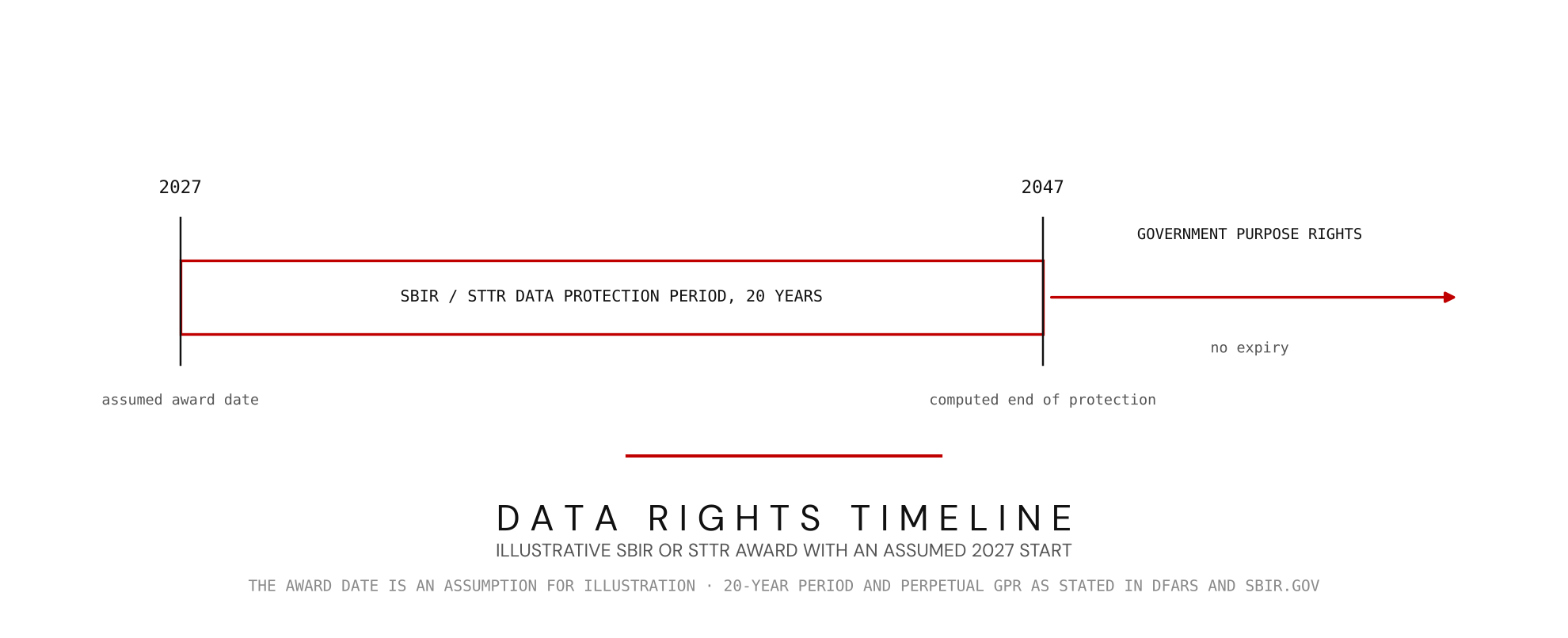
Computed from an assumed 2027 award date and the 20-year protection period cited with Table 5. The award date is an assumption, and the actual period starts at the date of the specific award.
The protection period bears on how SOL values its baselines. Under a 20-year period, SOL controls release of data produced under the award for two decades, which exceeds the usual life of a software generation, and the Government purpose rights that follow allow Government use and release for Government purposes only. Table 5 compares the instruments by title, Government license and protection period.
Table 5. Intellectual property and data rights terms by agreement instrument
| Instrument | Ownership | Government rights | Protection period | Basis | Evidence type |
|---|---|---|---|---|---|
| SBIR or STTR contract | Small business keeps title to data it generates | Government purpose rights after the protection period | 20 years from award | DFARS text and SBIR.gov116117 | Regulation; Government page |
| STTR research institution agreement | Set in a written agreement between the small business and the research institution before award | Not stated in the retrieved text | Not stated | SBIR.gov and law firm bulletin118119 | Government page; law firm commentary |
| Bayh-Dole subject inventions under an assistance agreement | Contractor may elect title to subject inventions | Nonexclusive, irrevocable license for Government purposes | Patent term | Standard patent rights clause120 | Regulation |
| Cooperative research and development agreement | Collaborating party may hold title to its inventions | Government license; exclusive license option for laboratory inventions in a field of use | Set by the agreement | Statute121122 | Statute |
| Technical data and software in a procurement contract | Contractor, for items developed at private expense and asserted before award | Unlimited rights assumed for anything not listed or marked | Not stated | DFARS texts123124 | Regulation |
| Research other transaction under the ARL announcement | Negotiable | Expanded protection can be negotiated | Negotiable | Government solicitation125 | Government solicitation |
Entries restate the cited provisions in short form. The retrieved passages of the Bayh-Dole clause and the CRADA statute were not read in full. Interpretation: the entries describe default allocations, and a negotiated agreement can change several of them.
6.2 STTR requires an agreement between the small business and the university, and the retrieved texts state no typical allocation
An STTR award requires a written agreement between the small business and the research institution that allocates intellectual property rights, and SBIR.gov states that the two parties must sign it before award.126 The research institution's share is at least 30 percent, and either organization may employ the principal investigator.127 None of the retrieved sources states what allocation the parties typically choose, so the question of typical terms between small businesses and universities under ARL agreements has no sourced answer in this paper.
The defaults that the retrieved law set a frame for negotiation. Under the Bayh-Dole standard clause a contractor may elect title to a subject invention, and the Government receives a license for Government purposes.128 A university that employs the inventor holds title under the default, and a small business that wants to commercialize a university invention needs a license from the university. Under a cooperative research and development agreement, a collaborating party can choose an exclusive license to laboratory inventions in a field of use, and a party holding an exclusive license holds the right of enforcement.129130 The ARL announcement allows research other transactions to include negotiated terms for expanded protection, and the parts of the announcement that cover award terms and general provisions were not reviewed.131
A university agreement for CF-JET benefits from five explicit terms. A schedule of background intellectual property lists the SOL baselines that the university may use for the project and states that the university acquires no rights in them. A clause on improvements states who holds title to improvements to SOL's baselines, since the default follows the inventor's employer. An option gives SOL an exclusive license to university inventions in the cold plate field of use for a stated period. A publication review period gives SOL time to remove proprietary baseline detail from a manuscript before release. A data clause states which party hosts CUI and which party reports a cyber incident. These terms are interpretation drawn from the defaults in Table 5, and no retrieved source reports them as typical. Whether a review period limited to removing SOL proprietary information preserves fundamental research status is a question for the university's export control office, because the retrieved university guidance treats sponsor publication restrictions as disqualifying.132
6.3 Technical data and software outside SBIR depend on assertions made before award
For technical data and computer software delivered under a procurement contract, the DFARS clause on identification and assertion of restrictions requires an offeror to list before award each item to be delivered with restricted Government rights, and it requires a basis for each assertion.133 The marking provision requires the contractor to apply restrictive markings that match the list, and technical data delivered without them can be released without restriction.134 A university subawardee that develops code with Government funds holds a different position from SOL, whose baselines SOL develops at private expense, and the contract has to record that difference for the Government to honor it.
7. Proof of Ownership for Algorithmic Baselines
7.1 No retrieved solicitation requires documentary proof of ownership, and the mechanisms found rely on assertion and marking
The search of Government texts found no DoD solicitation that requires an offeror to prove ownership of an algorithmic baseline with documents. The mechanisms that exist in the retrieved texts ask for assertions: a list of restricted items with a basis for each, markings that match the list, and for ARL a data management plan of two pages or fewer.135136137 A contracting officer who doubts an assertion can challenge it after award, and the retrieved texts do not state what documents the Government accepts to resolve a challenge. Table 6 lists the mechanisms and the gap.
Table 6. Mechanisms for asserting ownership of data and software baselines
| Mechanism | What the offeror submits | Government treatment | Basis | Evidence type |
|---|---|---|---|---|
| Pre-award assertion list under DFARS 252.227-7017 | A list of technical data and computer software to be delivered with restrictions, with the basis for each assertion | The Government assumes no restriction on items not listed | DFARS text138 | Regulation |
| Restrictive markings under DFARS 227.7103-10 | Markings on delivered technical data that match the assertion list | Unmarked data can be released without restriction | DFARS text139 | Regulation |
| SBIR and STTR data rights markings and redelivery | Markings that identify SBIR or STTR data and its protection period | Government treats marked data under the protection period | Procedures, guidance and information140 | Government guidance |
| ARL data management plan | A plan of no more than two pages with the proposal | Reviewed with the proposal; no ownership proof stated | Government solicitation141 | Government solicitation |
| Rights in AI models trained on Government-funded data | No retrieved solicitation states a requirement | No settled regulatory answer reported | Law firm commentary142 | Law firm commentary |
| Documentary proof of baseline ownership | None retrieved | Not stated | Search of the sources reviewed | Gap |
The last two rows record gaps found in the search. The statement about challenges rests on the structure of the assertion clause as retrieved. Interpretation: the absence of a documentary requirement in the sources reviewed does not rule out one in a solicitation that was not reviewed.
7.2 An offeror can assemble dated records that support each assertion
SOL's own documents describe a database that records the provenance of each simulation condition and solver version in its pipeline.143 A parallel record for the baselines themselves would support an assertion: dated source repository history that shows authorship, a ledger that ties each component to private funds, contributor agreements that assign rights to SOL and a list of third-party and open-source licenses. These are practices that SOL can adopt and that the retrieved texts do not require, so they are interpretation, offered as a way to make an assertion defensible.
SOL Aquifer's origin in HVAC modeling work with Alabama A&M University students creates a provenance question that a reviewer can raise.144 Code written by students can fall under university policy or under an employment or assignment arrangement, and the retrieved sources do not state the terms under which the students contributed. If SOL holds an assignment or license from that work and can identify which parts of the current baselines descend from it, the origin supports the assertion. If the records are missing, a reviewer can question whether SOL owns those components outright.
The strongest position separates three layers: baselines developed before the award at private expense, improvements developed under the award, and data generated by the award. Each layer takes a different assertion, and a clean boundary at the date of award, supported by dated records, prevents a dispute over mixed funding.
7.3 Rights in AI models trained on Government-funded data have no settled regulatory answer
Law firm commentary on artificial intelligence in defense contracting reports that the rules on rights in trained models and on the data used to train them remain unsettled.145 A surrogate model trained on data that mixes SOL's private coupon measurements with Government-funded prototype tests falls in that gap. The assertion list needs a separate entry for model weights, a statement of the training data's funding source and a statement of which data a delivered model can reproduce.
8. CUI Handling and On-Premises Compute
8.1 DFARS 252.204-7012 applies NIST SP 800-171 and a 72-hour reporting duty whatever the status of CMMC
DFARS 252.204-7012 requires a contractor that holds covered defense information on its systems to implement NIST SP 800-171, to report cyber incidents within 72 hours and to include the clause in subcontracts that involve such information.146147 NIST SP 800-171 Revision 2 contains 110 security requirements in 14 families.148149 NIST has also published a newer revision, and the retrieved sources do not establish when it would replace Revision 2 for purposes of the DFARS clause. The clause and the standard apply to the contract whether or not a CMMC level is required.
8.2 CMMC Phase 2 was suspended on 13 July 2026, and program offices may require only self-assessments
CMMC Phase 1 began on 10 November 2025 and adds Level 1 and Level 2 self-assessment requirements to applicable solicitations and contracts.150 Phase 2 was scheduled for 10 November 2026 and would have required assessment by a certified third-party assessor for Level 2.151152 On 13 July 2026 the Government suspended Phase 2, and program offices may require only Level 1 and Level 2 self-assessments during the suspension.153154 Trade press reports that class deviation 2026-O0025 locked the suspension into contracting practice, and the primary text of the deviation was not retrieved.155 The retrieved sources give no new date for Phase 2 (Table 7, Figure 5).
Table 7. CUI and cybersecurity requirements relevant to on-premises AI compute
| Requirement | Content | Status at 26 November 2026 | Basis | Evidence type |
|---|---|---|---|---|
| DFARS 252.204-7012 | Implement NIST SP 800-171 on systems that hold covered defense information; report cyber incidents within 72 hours; flow the clause to subcontractors | In force | DFARS text156 | Regulation |
| NIST SP 800-171 Revision 2 | 110 security requirements in 14 families for nonfederal systems that protect CUI | Baseline for self-assessment | Standards summary157158 | Standard; association summary |
| CMMC Phase 1 | Level 1 and Level 2 self-assessments in applicable solicitations and contracts | Began 10 November 2025; remains in force | Law firm alert159 | Law firm commentary |
| CMMC Phase 2 | Level 2 assessments by a certified third-party assessor | Scheduled for 10 November 2026; suspended 13 July 2026 | Law firm alerts160161 | Law firm commentary |
| Class deviation 2026-O0025 | Reported to lock the Phase 2 suspension into contracting practice | Primary text not retrieved | Trade news162 | Trade news |
| AI tools in a CUI environment | Vendor commentary on governance of AI tools at Level 2 | No primary Government guidance retrieved | Vendor blog163 | Vendor commentary |
Status entries restate the cited alerts and reports. The Phase 2 start date of 10 November 2026 passed during the suspension. Interpretation: a Level 2 self-assessment covers the same 110 requirements as the underlying standard, so the suspension removes the third-party assessment and leaves the control set in place.
Figure 5. CMMC phase dates and the suspension of Phase 2
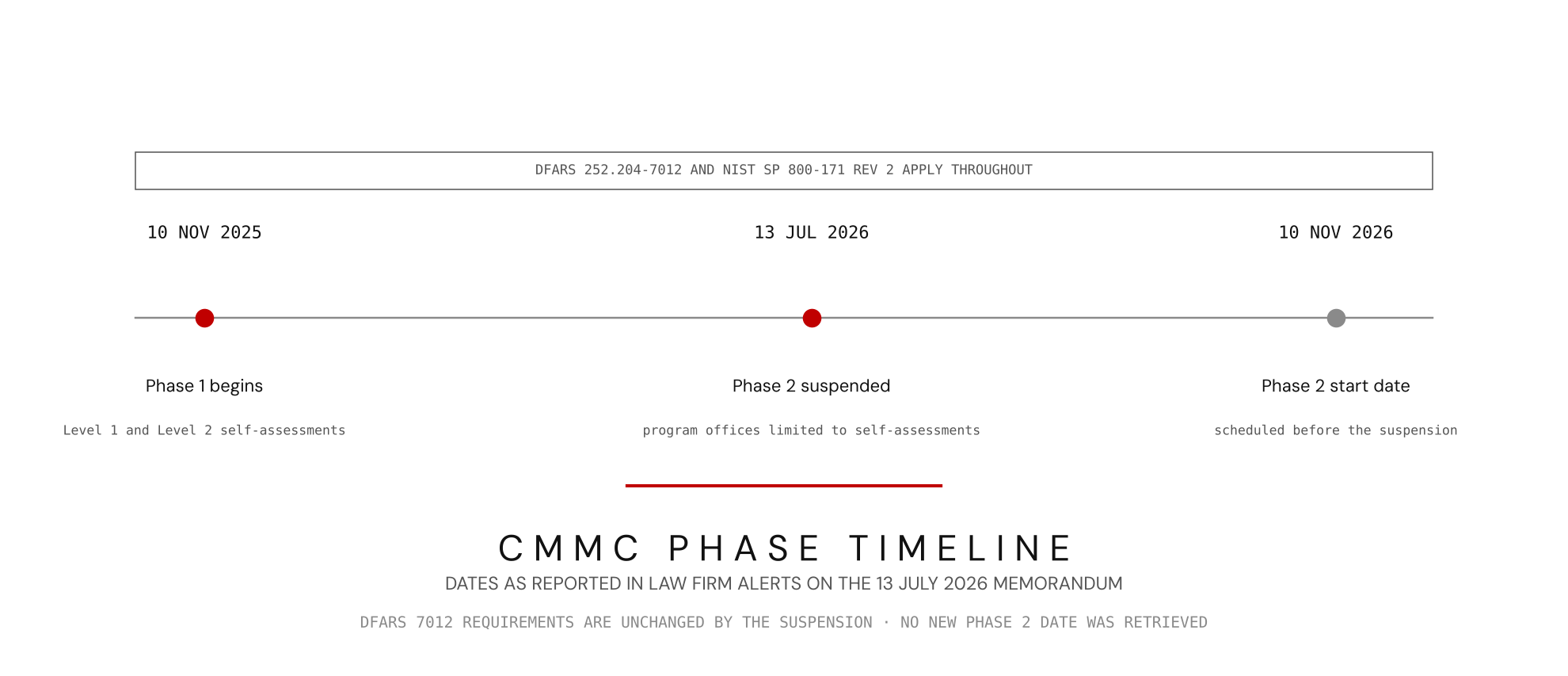
Dates as reported in the law firm alerts cited with Table 7. The 10 November 2026 date is shown as the scheduled start before the suspension, and no replacement date was retrieved.
8.3 An on-premises AI cluster that processes CUI needs the full control set, and the sources give no AI-specific rule
No retrieved Government source addresses AI compute specifically, and the only AI-specific treatment found is vendor commentary on whether AI tools can be used in a CMMC Level 2 environment.164 The standard's scope rule applies by its terms: a system that processes, stores or transmits CUI, with the components that protect it, falls under the 110 requirements. For CF-JET, that scope includes training nodes that read CUI data sets, the storage that holds them, the job scheduler and the administrator accounts. An on-premises cluster keeps the boundary inside SOL's own control, and a hosted AI service that receives CUI would add a provider to the boundary.
The question of whether CF-JET data is CUI depends on the award. Coupon, single-jet and prototype data that the solicitation marks as controlled becomes CUI, and data that SOL generates at private expense without such marking does not. A project plan that states the data categories at award, assigns each to a system and names the boundary lets SOL keep non-CUI baselines off the controlled cluster, which reduces the size of the system that the 110 requirements cover.
The 72-hour duty requires SOL to detect an incident and to report it within three days, and the clause reaches subcontractor systems that hold the same information.165 An incident plan for the CF-JET cluster names who decides that an event is reportable, who files the report and how SOL notifies a university partner whose system is affected. The plan also covers the university's own reporting duty under the flow-down. These elements follow from the clause and are interpretation, since the retrieved text was read in passages.
University partners meet the same rules from the other side. A university that receives CUI under a subaward receives the clause by flow-down, and the pilot announcement for HBCU and MSI institutions refers to general terms for CUI obligations without stating their content.166167 A university compute environment that holds CUI may be a gap for institutions with limited research computing staff, and a pairing of the ARO Trusted Partner Program with an STTR could address it by placing CUI work at a pre-vetted partner.168
9. Implications for the CF-JET Effort
9.1 Risks
The eligibility of a small business prime under ARL-BAA-0107 is unconfirmed. The topic text describes academic performers and the umbrella announcement lists for-profit applicants, so a whitepaper sent without a point-of-contact response risks a wasted effort.169170
HBCU and MSI vehicles can fund the university and cannot pay SOL. The 2026 pilot bars subawards and payments to collaborators, and the 2024 partnership limits collaborators to degree-granting institutions.171172
A split award can place hardware work outside fundamental research. The 6.3 category and physical items fall outside the exclusions, so SOL-site fabrication falls under contract-defined controls.173174
A publication limit on SOL baselines can remove fundamental research status from university work. One restrictive clause in a subaward can change the export control treatment of every result.175
Unasserted baselines can be released without restriction. The Government assumes no restriction on items omitted from the assertion list.176177
Control obligations on CUI start before any CMMC level applies. DFARS 252.204-7012 requires the 110 requirements and 72-hour reporting at the time the clause enters a contract.178
The retrieved sources leave several questions open. No source classifies a cold plate for export control, requires documented proof of baseline ownership, gives AI-specific CUI rules, states intermediary fees or terms, or gives the full text of ARL-BAA-0107.
9.2 Design implications
Ask the topic point of contact for written confirmation of prime eligibility and of the best fit among the three topics before drafting a whitepaper.
Structure the effort with a university performing modeling and AI work on campus under fundamental research terms, SOL performing hardware work at its site, and a written work breakdown that assigns each package a budget category.
Use an STTR, a BAA subaward or a cooperative research and development agreement to pay SOL, and use an institution-only vehicle to fund the university separately.
Execute the STTR intellectual property agreement with the university before proposal submission and state which baselines SOL contributes, which improvements the award produces and which party holds title to each.
Prepare an assertion list with a basis for each baseline, a separate entry for model weights and training data, and markings that match the list.
Define the CUI boundary in the proposal, keep non-CUI baselines outside it and implement the 110 requirements on the on-premises cluster from the first day that CUI enters the system.
9.3 Open research questions
What do the full texts of ARL-BAA-0107, 0038 and 0064 require for submission format, page limits and eligibility, and how does ARL-BAA-0064 relate to a cooling effort?
What allocation of intellectual property do small businesses and universities choose in ARL STTR agreements, and which terms do ARL contracting officers accept?
Which export classification applies to a printed jet-impingement cold plate and to AI design software that models it?
Does any DoD solicitation or contracting officer practice require documentary proof of ownership of an algorithmic baseline, and what evidence do reviewers accept?
What fees, intellectual property terms and eligibility rules apply to nonprofit intermediaries that manage Army other transaction agreements?
How do the primary texts of class deviation 2026-O0025 and any new CMMC schedule change the controls required for an on-premises AI cluster?
10. Conclusion
The vehicle decides the terms. A small business pairing a cold plate and an AI design pipeline with a university meets solicitation rules that favor academic performers, HBCU and MSI vehicles that pay institutions only, export rules that treat campus research and hardware differently, data rights that protect SOL for 20 years under SBIR or STTR, and cybersecurity duties that apply from the first CUI byte.
Seven gaps limit what this paper can state: the full text of ARL-BAA-0107, any requirement for proof of baseline ownership, the export classification of a cold plate, AI-specific CUI guidance, intermediary terms, the relation of ARL-BAA-0064 to the effort and the primary text of the CMMC deviation. Each gap can be closed with a question to the topic point of contact, a classification request or a review of the primary text.
Bibliography
“‘Technology’ or ‘Software’ That Arises During, or Results from, Fundamental Research.” 15 C.F.R. § 734.8. https://www.law.cornell.edu/cfr/text/15/734.8. Regulation; the operative sentence was read in the Government Publishing Office edition of the Code of Federal Regulations (1 January 2018 and 1 January 2023 editions).
Cooperative Research and Development Agreements. 15 U.S.C. § 3710a. https://www.law.cornell.edu/uscode/text/15/3710a. Statute (Cornell Legal Information Institute copy); retrieved passages only.
Cooperative Research and Development Agreements. 15 U.S.C. § 3710a. United States Code, 2016 edition. https://www.govinfo.gov/content/pkg/USCODE-2016-title15/pdf/USCODE-2016-title15-chap63-sec3710a.pdf. Statute; retrieved passages only.
“Standard Patent Rights Clauses.” 37 C.F.R. § 401.14. https://www.law.cornell.edu/cfr/text/37/401.14. Regulation (Cornell Legal Information Institute copy); retrieved passages only.
U.S. Army DEVCOM Army Research Laboratory. Broad Agency Announcement for Foundational Research. W911NF-23-S-0001, Amendment 4, 8 January 2025. https://arl.devcom.army.mil/wp-content/uploads/sites/3/2025/01/DEVCOM-ARL-BAA_W911NF23S0001-Amendment-4_JAN-8-2025.pdf. Government solicitation; only the first 100,000 of about 200,000 characters were analyzed, through part of the review and selection process, so later sections (including award terms and general provisions) were not reviewed.
DEVCOM Army Research Laboratory. “ARL Broad Agency Announcement (BAA).” Collaboration web page, accessed 26 November 2026. https://arl.devcom.army.mil/collaborate-with-us/opportunity/arl-baa/. Government page.
DEVCOM Army Research Laboratory Public Affairs. “Army’s Fundamental Research Lab Partnering with Industry to Advance AI.” 25 March 2026. https://www.army.mil/article/291335/armys_fundamental_research_lab_partnering_with_industry_to_advance_ai. Government news article.
Brady, Jenna. “Open Campus Initiative Allows Open Collaboration for Army Research Laboratory.” ARL Public Affairs, 5 September 2014. https://www.army.mil/article/133081/. Government news article; the CRADA counts are for fiscal years 2013 and 2014.
DEVCOM Army Research Laboratory. “ARL Opportunities.” Search-result summary of the ARL vendor submission portal entry for ARL-BAA-0107, accessed 26 November 2026. https://cftste.experience.crmforce.mil/arlext/s/arl-opportunities. Government portal; the page itself did not render when fetched, so the entry is known only from the search-result text, which is cut off after TRL 5.
U.S. Army DEVCOM Army Research Laboratory. “Autonomous Sensing and Information Fusion for Advanced Indications and Warnings (ARL-BAA-0064).” In Current Research Topics for DEVCOM ARL BAA for Foundational Research, 9 December 2024. https://files.simpler.grants.gov/opportunities/5e185327-5f25-4c09-889a-43615e1f54da/attachments/e4621f8a-b19c-40ec-8c59-6611cc4fa276/Current_Research_Topics_for_DEVCOM_ARL_BAA_9_Dec2024.pdf. Government document; the December 2024 snapshot lists neither research type nor audience, and ARL-BAA-0107 does not appear in it.
DEVCOM Army Research Laboratory Public Affairs. “Army Business Solution Accelerates Collaborative Drone Defense Research.” 12 August 2026. https://www.army.mil/article/294579/army_business_solution_accelerates_collaborative_drone_defense_research. Government news article; it concerns human-subjects review reliance agreements, and the article does not state the legal form of the intermediary.
Army Materiel Command. “Request for Information – University Partnership Models.” DEVCOM-ARL-RFI-25-01, Amendment 01, 22 November 2024. Listing at Simpler.Grants.gov, last updated 13 May 2026. https://simpler.grants.gov/opportunity/ab5fa29f-4625-4afc-8c27-0832c7ab547d. Government notice; only the listing was read, not the RFI text.
U.S. Army DEVCOM Army Research Laboratory. “Artificial Intelligence and Machine Learning with Extremely Sparse Data (ARL-BAA-0038).” In Current Research Topics for DEVCOM ARL BAA for Foundational Research, 9 December 2024. https://files.simpler.grants.gov/opportunities/5e185327-5f25-4c09-889a-43615e1f54da/attachments/e4621f8a-b19c-40ec-8c59-6611cc4fa276/Current_Research_Topics_for_DEVCOM_ARL_BAA_9_Dec2024.pdf.
Army SBIR/STTR Program. “Academia with Small Business.” Program web page, accessed 26 November 2026. https://armysbir.army.mil/getinvolved/academia-with-small-business/. Government page.
Arnold & Porter. “Reassessing CMMC.” Advisory, July 2026. https://www.arnoldporter.com/en/perspectives/advisories/2026/07/reassessing-cmmc. Law firm commentary quoting the 13 July 2026 memorandum.
DEVCOM Army Research Laboratory Public Affairs. “Army Research Office to Launch Academic Initiative for Sensitive, High-Impact Research.” 4 May 2026. https://www.army.mil/article/292179/army_research_office_to_launch_academic_initiative_for_sensitive_high_impact_research. Government news article; it gives no dollar amounts and does not address publication or export control, and the multiple-award contract details are on SAM.gov, which was not reviewed.
DEVCOM Army Research Laboratory Public Affairs. “Army Innovation Moves into Operational Use under ECU-Army Reserve Agreement.” 28 August 2026. https://www.army.mil/article/294952. Government news article.
GovConWire. “By Light, CMI2 Form JV to Expand West Virginia’s Cybersecurity Sector.” 2023. https://www.govconwire.com/2023/08/by-light-cmi2-form-jv-to-expand-west-virginias-cybersecurity-sector. Trade news; it describes the Civil-Military Innovation Institute as a nonprofit organization.
HigherGov. “W911NF2590002, Other Transaction Agreement, Soldiers As Researchers (SOAR).” Contract record, accessed 26 November 2026. https://www.highergov.com/contract/W911NF2590002/. Commercial aggregator of federal award data; it reports the awardee as Civil-Military Innovation Institute and a potential award of $52.4 million.
“Contractor Identification and Marking of Technical Data to Be Furnished with Restrictive Markings.” DFARS 227.7103-10. acquisition.gov, accessed 26 November 2026. https://acquisition.gov/node/35668/printable/pdf. Regulation; retrieved passages only.
“Safeguarding Covered Defense Information and Cyber Incident Reporting.” DFARS 252.204-7012. acquisition.gov, accessed 26 November 2026. https://www.acquisition.gov/dfars/252.204-7012-safeguarding-covered-defense-information-and-cyber-incident-reporting%2E. Regulation; retrieved passages only.
“Safeguarding Covered Defense Information and Cyber Incident Reporting.” DFARS 252.204-7012, definitions. acquisition.gov, accessed 26 November 2026. https://www.acquisition.gov/node/36383/printable/print. Regulation; retrieved passages only.
“Identification and Assertion of Use, Release, or Disclosure Restrictions.” DFARS 252.227-7017. acquisition.gov, accessed 26 November 2026. https://www.acquisition.gov/node/36598/printable/print. Regulation; retrieved passages only.
Defense Federal Acquisition Regulation Supplement. Text on SBIR/STTR data rights and the data protection period. acquisition.gov, accessed 26 November 2026. https://www.acquisition.gov/node/62423/printable/print. Regulation; the retrieved page copy did not display its section number.
Under Secretary of Defense for Acquisition, Technology, and Logistics. “Contracted Fundamental Research.” Memorandum, 26 June 2008. https://www.acq.osd.mil/dpap/dars/pgi/docs/Contracted_Fundamental_Research_Memo_(06-26-2008).pdf. Government memorandum; the definition of contracted fundamental research was read in a university-hosted copy, and later guidance replaced the budget category names with RDT&E categories.
Under Secretary of Defense for Acquisition, Technology, and Logistics. “Contracted Fundamental Research.” Memorandum on National Security Decision Directive 189. Copy hosted by the Harvard Center for Astrophysics. https://lweb.cfa.harvard.edu/spp/ec/ecdocs/NSDD_Memo189_fundamentalrsch.pdf. Government memorandum read in a university-hosted copy; the date of the memorandum does not appear in the retrieved passage.
Department of Defense, Basic Research Office. “Fundamental Research Guidance.” https://basicresearch.defense.gov/Portals/61/Documents/Research%20Security/Fundamental%20Research%20Guidance.pdf. Government guidance; the retrieved passage was cut off in the sentence on 6.2 research performed on a university campus, which is completed from the 2008 memorandum.
Aftergood, Steven. “DoD Research Not to Be Restricted.” Secrecy News, Federation of American Scientists, 3 June 2010. https://sgp.fas.org/news/secrecy/2010/06/060310.html. Advocacy newsletter reporting the 24 May 2010 memorandum.
U.S. Army Contracting Command–Aberdeen Proving Ground, Research Triangle Park Division, for DEVCOM ARL and OUSD(R&E). Historically Black Colleges and Universities and Other Minority-Serving Institutions Pilot Program to Increase Research Capacity, Fiscal Year 2026. Funding Opportunity Announcement W911NF-26-S-0075. https://files.simpler.grants.gov/opportunities/11efd047-3fa4-4de3-843f-79fda61924ba/attachments/8f3cd2d3-db8b-4ad9-84de-df975268fada/W911NF26S0075_Pilot_Program.pdf. Government solicitation; section references were taken from a summary of the full text, with application due 10 April 2026 and awards expected in late August 2026.
U.S. Army Research Office. DEVCOM ARL HBCU/MI Research Partnerships. Funding Opportunity Announcement W911NF-24-S-0002, Amendment 04. https://apply07.grants.gov/grantsws/rest/opportunity/att/download/335417. Government solicitation; the first 100,000 of about 154,000 characters were analyzed, so the administrative and national policy requirements (including any export control language) were not reviewed. The announcement uses the number W911NF-24-S-0001 in two submission instructions.
Stony Brook University Research Security. “Regulatory Definitions of Publicly Available, Public Domain, and Published.” accessed 26 November 2026. https://www.stonybrook.edu/research-security/_archive/_export-control-regulations/_federal-export-control-regulations/publicly-available.html. University compliance office page reproducing 22 C.F.R. § 120.34; secondary to the regulation.
Stony Brook University Research Security. “Publicly Available.” Export control page, accessed 26 November 2026. https://www.stonybrook.edu/commcms/ors/export_controls/Export_Control_Regulations/Federal_Export_Control_Regulations/Publicly-Available.php. University compliance office page; secondary to the regulation.
U.S. Army Contracting Command–New Jersey. Other Transaction Agreement W15QKN-16-9-1002 with the Medical CBRN Defense Consortium, c/o Advanced Technology International. https://www.hhs.gov/sites/default/files/base-ota-consortium-agreement-covid-19-vaccine.pdf. Government agreement posted by another agency; it concerns a biodefense consortium, so it shows the consortium-manager structure and not terms specific to cold plates.
National Law Review. “Artificial Intelligence in Defense Contracting: What Contractors Need to Know Now.” accessed 26 November 2026. https://natlawreview.com/article/artificial-intelligence-defense-contracting-what-contractors-need-know-now. Law firm commentary; the author is not identified in the retrieved text.
Nextgov/FCW. “CMMC’s Phase 2 Suspension Locked in with Binding Regulation.” September 2026. https://www.nextgov.com/acquisition/2026/09/cmmcs-phase-2-suspension-locked-binding-regulation/415890/. Trade news.
Ross, Ron, Victoria Pillitteri, Kelley Dempsey, and Mark Riddle. Protecting Controlled Unclassified Information in Nonfederal Systems and Organizations. NIST Special Publication 800-171, Revision 2. Gaithersburg, MD: National Institute of Standards and Technology, February 2020, updated 28 January 2021. https://csrc.nist.gov/pubs/sp/800/171/r2/upd1/final. Standard; the catalog page was read and the requirement text was not.
EDUCAUSE Library. “NIST SP 800-171 Overview.” 2022. https://library.educause.edu/resources/2022/9/nist-sp-800-171-overview. Higher education association summary of the NIST publication; the NIST page itself was retrieved without the counts.
U.S. Army Contracting Command–Aberdeen Proving Ground, Research Triangle Park Division, for DEVCOM ARL and the Office of the Secretary of Defense. Funding Opportunity Announcement W911NF-24-S-0009, Amendment 1. https://files.simpler.grants.gov/opportunities/4e06c54f-060f-43bc-ad33-f3e7ce20727f/attachments/81d3170f-f8e6-4cf7-b925-30f36f4fe7a4/OSD_FOA_Amendment_1.pdf. Government solicitation; only the introductory passages returned by a search were read, and the full program title was not retrieved.
Defense Pricing and Contracting. “PGI 227.7104-2 Rights in SBIR or STTR Data.” acquisition.gov, accessed 26 November 2026. https://www.acquisition.gov/node/56100/printable/print. Government procedures, guidance and information.
Small Business Administration. “Small Business Innovation Research Program and Small Business Technology Transfer Program Policy Directive.” Federal Register 84, no. 63 (2 April 2019): 12794. https://www.govinfo.gov/link/fr/84/12824. Government notice; the May 2023 directive that DFARS guidance cites was not reviewed.
U.S. Small Business Administration. “About SBIR/STTR.” SBIR.gov, accessed 27 November 2026. https://www.sbir.gov/about. Government page; the retrieved page lists Phase I and Phase II award guidelines effective 16 October 2026.
SBIR.gov. “Frequently Asked Questions: Data Rights.” accessed 26 November 2026. https://www.sbir.gov/faq/data-rights. Government page.
Secureframe. “AI Governance for CMMC Level 2: Can You Use AI Tools in a CUI Environment?” accessed 26 November 2026. https://secureframe.com/blog/cmmc-level-2-ai-governance. Compliance software vendor blog.
SOL Engineering Services, LLC. CF-JET: AI/ML-Enabled Design and Development of an Additively Manufactured, Liquid-Cooled Jet-Impingement Cold Plate with Optimized Carbon Fiber Target Plate. Proposal, Rev Final 2, n.d.
SOL Engineering Services, LLC. SOL Aquifer software pipeline diagram. n.d.
SOL Engineering Services, LLC. “Modeling HVAC System Performance: Code as Architecture Approach to AI.” Work carried out with Alabama A&M University students, n.d.
Taft Stettinius & Hollister LLP. “New SBIR/STTR Rules Moving Forward.” Law bulletin, accessed 26 November 2026. https://www.taftlaw.com/news-events/law-bulletins/new-sbir-sttr-rules-moving-forward/. Law firm commentary on the 2019 directive.
University of Texas at Arlington. “Fundamental Research.” Export control guidance page, accessed 26 November 2026. https://resources.uta.edu/research/regulatory-services/export-control/fundamental-research.php. University compliance office guidance; secondary to the regulation.
Wiley Rein LLP. “DOD Pauses CMMC 2.0 Implementation: A Big Deal with Little Immediate Impact.” Client alert, 17 July 2026. https://www.wiley.law/alert-DOD-Pauses-CMMC-2-0-Implementation-A-Big-Deal-with-Little-Immediate-Impact. Law firm commentary on the 13 July 2026 memorandum.