
Executive Summary
Liquid cooling for AI data centers sets the commercial reference for the price and performance of any new cold plate, and analyst estimates of that market in 2024 range from $0.87 billion to $4.97 billion, a 5.7-fold spread (computed, Table 1).12 The spread follows from scope: one estimate counts investment, another counts manufacturer revenue, and others count solutions and services.3 Two sources put cold plates alone near $0.3 billion in 2024.45 The CF-JET effort addresses Army ground vehicle and directed-energy loads and commercial inverter and accelerator loads, and the transition funding it can reach spans ceilings from $167,500 to $30 million (Table 5).
Market size depends on scope more than on forecast growth. Stated growth rates range from 6.3 percent for cold plates in all applications to 51.9 percent for an investment measure (Table 1). One publisher revised its 2030 value down by 12.0 percent between April and August 2025 (computed).6
Suppliers are being absorbed by power and fluids groups. Eaton agreed to buy Boyd Thermal at $9.5 billion, Ecolab to buy CoolIT Systems at $4.75 billion, and Schneider Electric bought a 75 percent interest in Motivair for $850 million, which sum to $15.1 billion in stated prices (computed, Table 2). Multiples of sales range from 5.6 to 8.6 (computed).
Accelerator power has risen 3.3-fold in four years. Reported thermal design power moved from 700 W for the H100 in 2022 to 2,300 W for Vera Rubin in 2026, and Dell’Oro projects leading-edge parts beyond 4,000 W in 2029 (Table 3).789 Applying 0.02 K/W, the CF-JET resistance, gives a coolant-to-case rise of 46 K at 2,300 W and 80 K at 4,000 W (computed).
Vendor claims exceed the CF-JET design point in power, flux and resistance, and none has independent test evidence. CoolIT reports a 4,000 W single-phase cold plate with resistance under 0.009 °C/W, and Accelsius reports 4,500 W on a thermal test vehicle.1011 The CF-JET plate-average flux is 41.7 W/cm² against a vendor claim over 300 W/cm² and a DOE module target over 400 W/cm² (Figure 4).
Quantified military loads cluster in power conversion and radar. An Army vehicle microgrid supplies 100 kW per vehicle, the DE M-SHORAD weapon is rated 50 kW class, and AESA transmit/receive modules must stay under 80 °C.121314 No quantified heat loads were retrieved for unmanned aircraft, expeditionary microgrid inverters, renewable inverters, rail, marine or industrial lasers.
Transition ceilings differ 13-fold between the SBA Phase II guideline and a Strategic Breakthrough Award. The Phase II guideline is $2.24 million and the Award ceiling is $30 million with 1:1 matching; CATALYST offers up to $15 million per business (Table 5, Figure 5).151617 Ceilings vary by year and solicitation.
Engineering software uses five licensing models, and no retrieved source gives prices for AI engineering toolkits. Perpetual with maintenance, subscription, pay-per-use units, checked-out tokens and open source under Apache 2.0 are all in use (Table 6).181920
1. Introduction and Scope
The CF-JET proposal describes a three-dimensional printed jet-impingement cold plate with interleaved return ports and a carbon fiber target plate with perpendicular pitch fiber inserts, sealed by a thin electroplated coolant face.21 The design point is 1.5 kW on a 60 mm by 60 mm footprint, with 50/50 water-glycol entering at 65 °C at 4 to 8 L/min, a pressure drop of 30 kPa or less and a thermal resistance of 0.02 K/W. Those values give a plate-average heat flux of 41.7 W/cm² and a coolant-to-case rise of 30 K at full load (computed). The effort responds to ARL-BAA-0107, draws on ARL-BAA-0038 and uses elements of ARL-BAA-0064.22
Figure 1. Military and commercial uses, the CF-JET design point and the transition pathway
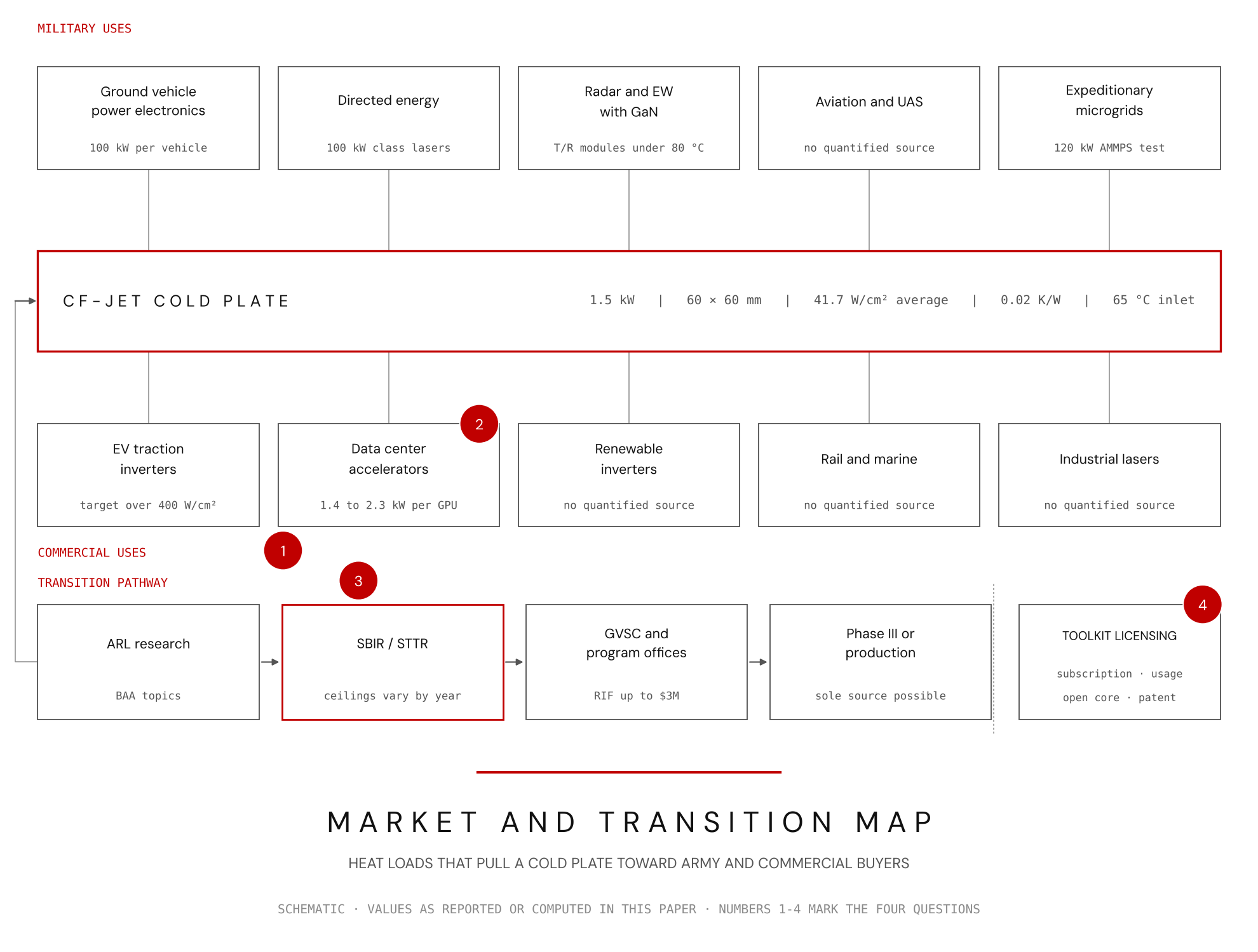
Schematic. Values are those reported or computed in this paper; boxes marked “no quantified source” are uses for which no sourced figure was retrieved. Markers 1 to 4 locate the four questions answered here.
SOL Engineering Services describes a software pipeline, SOL Aquifer, that codifies engineering steps as code: scripted condition sweeps, physics solvers in code, a SQL database that records provenance, and surrogate training with uncertainty quantification.23 The same documents describe uncertainty-aware neuro-symbolic inference, which combines codified physics and rules with learned surrogates, and a data flywheel that recalibrates the surrogates from coupon, single-jet and prototype data. SOL Aquifer originated in HVAC modeling work done with Alabama A&M University students.24 These capabilities are proposed or demonstrated by SOL, and the sources cited in this paper for markets, heat loads, transition funding and licensing are independent of SOL.
Figure 1 maps the four questions. The first asks how large the market for liquid cold plates and direct-to-chip cooling is, how fast it is growing and which suppliers lead it. The second asks what heat loads current and upcoming accelerators impose and how cooling demand is changing. The third asks how research at the Army Research Laboratory (ARL) can move to the Ground Vehicle Systems Center (GVSC) of DEVCOM, to program offices and to SBIR and STTR Phase II and Phase III awards. The fourth asks which licensing models apply to AI engineering design toolkits.
The military uses in scope are ground vehicle power electronics, directed energy, radar and electronic warfare with gallium nitride (GaN) devices, aviation and unmanned aircraft, and expeditionary microgrids. The commercial uses are electric vehicle traction inverters, data center direct-to-chip cooling for high-power GPUs and high-bandwidth memory, renewable energy inverters, rail and marine electrification, and industrial lasers. Where a use has no quantified source in the retrieved material, the paper states the gap with the use.
2. Market Size, Growth and Leading Suppliers
2.1 Analyst estimates of the 2024 market differ 5.7-fold, and scope accounts for the spread
Table 1 lists ten commercial estimates of liquid cooling markets. The lowest 2024 value, $0.87 billion from Arizton, counts investment.25 The highest, $4.97 billion from the April 2025 edition of 360iResearch, counts a broader market, and the ratio between them is 5.7 (computed).26 Dell’Oro counts manufacturer revenue and reports about $3 billion for 2025, which falls between the two measures but belongs to a different year.27 The retrieved summaries do not publish the cost and equipment categories behind each total, so the spread cannot be allocated among them.
Table 1. Commercial estimates of liquid cooling market size and growth
| Source | Scope | Base year value | End year value | Stated CAGR (%) | CAGR from endpoints (%) | Evidence type |
|---|---|---|---|---|---|---|
| Arizton | Data center liquid cooling, investment | 2024: $0.87 B | 2030: $10.70 B | 51.93 | 51.9 | Analyst report28 |
| 360iResearch (April 2025) | Data center liquid cooling | 2024: $4.97 B | 2030: $12.71 B | 16.91 | 16.9 | Analyst report29 |
| 360iResearch (August 2025) | Data center liquid cooling | 2024: $4.75 B | 2030: $11.18 B | 15.31 | 15.3 | Analyst report30 |
| ABI Research | Data center liquid cooling | 2024: $1.2 B | 2030: $3.5 B | 20 | 19.5 | Analyst report31 |
| Fortune Business Insights | Data center liquid cooling | 2025: $8.01 B | 2034: $42.70 B | 20.44 | 20.4 | Analyst report32 |
| MarketsandMarkets | Data center liquid cooling | 2026: $4.07 B | 2033: $27.65 B | 31.5 | 31.5 | Analyst report33 |
| Dell’Oro Group (January 2026) | Liquid cooling, manufacturer revenue | 2025: about $3 B | 2029: about $7 B | Not stated | 23.6 (derived) | Analyst press release34 |
| Dell’Oro Group (August 2025) | Direct liquid cooling within thermal management | 2024: $1.1 B | 2029: $5.8 B | Not stated | 39.4 (derived) | Analyst press release35 |
| Technavio | Liquid cooling for AI data centers | 2025: 0.84 B (derived) | 2030: 3.32 B (derived) | 31.7 | 31.7 | Analyst report36 |
| Global Industry Analysts | Cold plates, all applications | 2024: $0.3347 B | 2030: $0.4817 B | 6.3 | 6.3 | Analyst report37 |
CAGR from endpoints is computed from the two stated values over the number of years between them. Rows marked derived use a stated increase and growth rate (Technavio) or two stated values with no stated growth rate (Dell’Oro). Values are as published in the summaries retrieved; full reports were not reviewed. Scopes differ and the rows are not additive.
Revisions within one publisher show the same sensitivity. 360iResearch lowered its 2024 value from $4.97 billion to $4.75 billion and its 2030 value from $12.71 billion to $11.18 billion between the April and August 2025 editions, changes of -4.4 and -12.0 percent (computed).38 The stated growth rates cover a 45.6-point range, from the 6.3 percent of the all-application cold plate estimate to the 51.9 percent of the investment measure (computed). The endpoint calculation reproduces each stated rate within 0.5 percentage points, so the differences originate in the published values.
Figure 2. Five estimates of data center liquid cooling market size, base year and forecast year
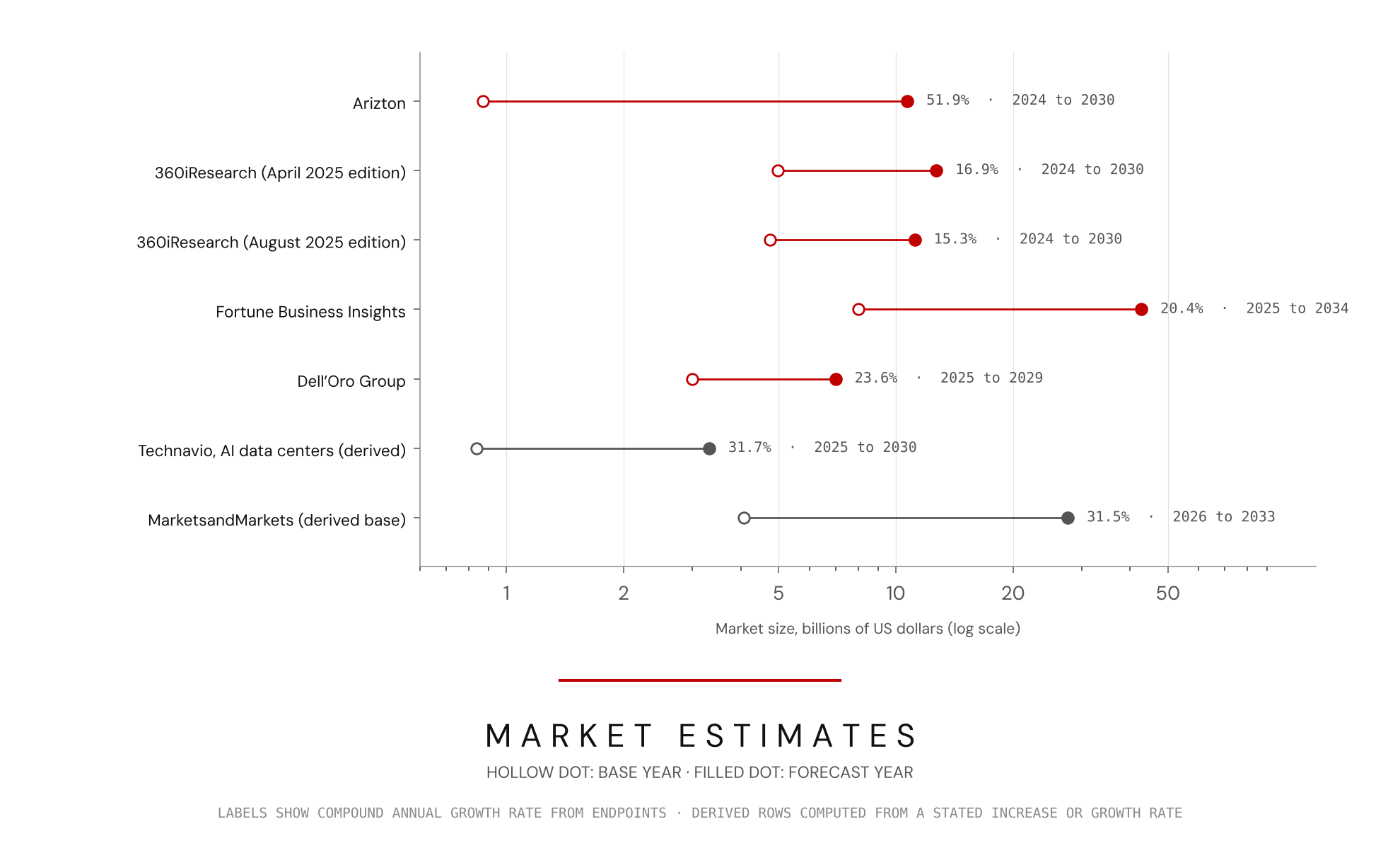
Drawn from Table 1 on a logarithmic axis. Labels show compound annual growth computed from the endpoints. Scopes differ among the five estimates.
2.2 Cold plates are reported separately by two sources at about $0.3 billion in 2024, a minority share of the larger totals
Technavio reports a cold plate segment of $293.84 million in 2024 within its liquid cooling for AI data centers market.39 Global Industry Analysts reports $334.7 million for cold plates in all applications in 2024, rising to $481.7 million in 2030 at 6.3 percent a year.40 The two values differ by 14 percent (computed) despite different scopes. Against the 2024 totals in Table 1, a cold plate value of $0.29 billion is 6 percent of the highest total and 34 percent of the lowest (computed).
The Dell’Oro figures show how scope changes a forecast. The August 2025 edition puts direct liquid cooling inside thermal management at $1.1 billion in 2024 and $5.8 billion in 2029, a computed growth rate of 39.4 percent a year.41 The January 2026 edition reports about $3 billion for liquid cooling in 2025 and about $7 billion in 2029.42 The two editions measure different categories, so the 2029 values of $5.8 billion and $7 billion cannot be differenced to infer a revision. No retrieved estimate covers cold plates for military vehicles, radar, inverters or industrial lasers, and the data center values are the only quantified base for the cold plate market.
A planning range for cold plate revenue can be bracketed from the two cold plate values, with the extrapolation labeled as a scenario. If the Technavio cold plate segment of $0.29 billion in 2024 grew at the 6.3 percent of the Global Industry Analysts estimate, it would reach about $0.42 billion in 2030, and if it grew at the 31.7 percent that Technavio states for its total market it would reach about $1.53 billion, a 3.6-fold difference (computed scenario). The bracket shows that the growth assumption matters more than the 2024 base, and it shows that the cold plate segment alone is an addressable market of the order of one billion dollars by the end of the decade under the faster assumption.
2.3 Three named suppliers changed hands at $15.1 billion in stated prices and 5.6 to 8.6 times sales
Table 2 collects the transactions that involve cold plate and direct-to-chip suppliers. Eaton agreed to buy Boyd Thermal for $9.5 billion at 22.5 times estimated 2026 adjusted EBITDA, which implies about $422 million of adjusted EBITDA (derived).43 Boyd’s forecast 2026 sales are $1.7 billion, of which $1.5 billion, or 88 percent, is liquid cooling. Ecolab agreed to buy CoolIT Systems from funds managed by KKR for $4.75 billion in cash against about $550 million of expected sales over 12 months, and a trade association item reports that the transaction closed ahead of the expected date with CoolIT sales growth over 100 percent for the year to date.4445 In October 2024 Schneider Electric agreed to pay $850 million in cash for a 75 percent stake in Motivair, with the remaining 25 percent expected to follow by 2028.46
Table 2. Acquisitions of liquid cooling and cold plate suppliers, 2024 to 2026
| Supplier | Transaction | Stated price | Disclosed sales basis | Multiple (computed) | Evidence type |
|---|---|---|---|---|---|
| Boyd Thermal | Eaton agreement, announced 3 November 2025; close expected in the second quarter of 2026 | $9.5 B enterprise value | 2026 sales forecast $1.7 B, of which $1.5 B liquid cooling | 5.59 × sales; 6.33 × liquid cooling sales; 22.5 × adjusted EBITDA (stated) | Company press release47 |
| CoolIT Systems | Ecolab agreement, 20 March 2026; closed ahead of the expected date | $4.75 B | About $550 M expected sales over 12 months | 8.6 × forward sales | Company filing; trade news4849 |
| Motivair | Schneider Electric purchase of a 75 percent interest, October 2024; remainder expected by 2028 | $850 M for 75 percent ($1.13 B for 100 percent, derived) | Not disclosed | Not computed | Trade press50 |
| Strategic Thermal Labs | Vertiv acquisition, 2026 | Not stated | Not disclosed | Not computed | Company press release51 |
| PurgeRite | Vertiv acquisition reported March 2026 | About $1 B (reported) | Not disclosed | Not computed | Financial news site52 |
Multiples divide the stated price by the stated or forecast sales and are computed here. Boyd’s closing was expected in the second quarter of 2026, and no retrieved source confirms it. The Motivair full-value figure assumes the 75 percent price scales to 100 percent.
The three priced transactions sum to $15.1 billion (computed, with the Motivair price covering 75 percent). Multiples of sales range from 5.6 for Boyd’s total forecast sales to 8.6 for CoolIT’s forward sales, and Boyd’s multiple of liquid cooling sales is 6.3 (computed). Vertiv bought Strategic Thermal Labs, which it describes as adding cold-plate design, server-side liquid cooling and high-density thermal validation capability, and a financial news site reports a purchase of PurgeRite for about $1 billion, a flushing, purging and filtration services firm.5354
NVIDIA’s own platform communication names suppliers by role. It states that Schneider Electric’s liquid-cooling infrastructure supports up to 132 kW per rack for GB200 NVL72 deployments and that CoolIT’s CHx2000 coolant distribution units provide 2 MW of cooling capacity at a 5 °C approach temperature for GB300 NVL72 deployments.55 The statement identifies two of the Table 2 suppliers as qualified partners for specific rack generations, and it is vendor material that describes capability and gives no market share. No retrieved source ranks suppliers by cold plate revenue, so the order of leadership among Boyd, CoolIT, Motivair and Vertiv cannot be established from the retrieved evidence.
2.4 Consolidation places cold plate technology inside power and fluids groups that act as buyers, partners and competitors
The buyers in Table 2 are electrical equipment, energy management, water and chemistry, and data center infrastructure companies. Schneider Electric reports Motivair inside its Energy Management business, and Ecolab describes the CoolIT purchase as an end-to-end fluid management and cooling platform for AI data centers.5657 Vertiv states that its acquisition of Strategic Thermal Labs does not change its commitment to an open ecosystem approach.58 For a university or small-business technology the consequence is a customer base with large balance sheets and a stated interest in cold plate design and thermal validation capability.
Independent suppliers remain. Accelsius reports a two-phase cold plate test at 4,500 W, and Advanced Cooling Technologies (ACT) moved a Navy SBIR cooling card into a tactical terminal during Phase II, with $2 million in manufacturing orders reported by the Navy program office.5960 The ACT example is the closest retrieved precedent for a small cold plate company moving a thermal product into a military program office. The assessment here is that a cold plate technology with documented validation evidence has several potential acquirers whose stated interest includes the validation capability itself.
3. Accelerator Heat Loads and Cooling Demand
3.1 Accelerator power rose from 700 W to a reported 2,300 W between 2022 and 2026 and is projected over 4,000 W by 2029
Table 3 lists thermal design power for nine accelerator entries. The NVIDIA H100 SXM is rated at 700 W, the AMD MI300X at 750 W, the MI325X at 1,000 W, the NVIDIA GB200 at 1,200 W and the AMD MI355X at 1,400 W in trade press reports.6162636465 The GB300 is reported at 1,400 W by trade press relaying an analyst report, and the Rubin generation at 2,300 W, up from 1,800 W originally announced, by trade press relaying an investment bank note.6667 SemiAnalysis describes 2,300 W as a Max-P profile and 1,800 W as a Max-Q profile, both default power profiles.68 Rubin Ultra is reported at 3,600 W, and Dell’Oro projects that leading-edge GPUs will exceed 4,000 W by 2029.6970
Table 3. Accelerator thermal design power, case-to-coolant rise at 0.02 K/W and plate area at 41.7 W/cm² (computed columns)
| Accelerator | Maker | Year | Power (W) | Rise at 0.02 K/W (K) | Plate area at 41.7 W/cm² (cm²) | Multiple of 36 cm² plate | Evidence type |
|---|---|---|---|---|---|---|---|
| H100 | NVIDIA | 2022 | 700 | 14 | 16.8 | 0.47 | Trade press71 |
| MI300X | AMD | 2023 | 750 | 15 | 18.0 | 0.50 | Trade press72 |
| MI325X | AMD | 2024 | 1,000 | 20 | 24.0 | 0.67 | Trade press73 |
| GB200 | NVIDIA | 2024 | 1,200 | 24 | 28.8 | 0.80 | Trade press74 |
| MI355X | AMD | 2025 | 1,400 | 28 | 33.6 | 0.93 | Trade press75 |
| GB300 | NVIDIA | 2025 | 1,400 | 28 | 33.6 | 0.93 | Trade press relaying an analyst report76 |
| Rubin | NVIDIA | 2026 | 2,300 | 46 | 55.2 | 1.53 | Reported, analyst note via trade press7778 |
| Rubin Ultra | NVIDIA | n.d. | 3,600 | 72 | 86.4 | 2.40 | Reported, trade press79 |
| Leading-edge accelerator, projected | Dell’Oro | 2029 | 4,000 | 80 | 96.0 | 2.67 | Analyst projection80 |
Power values are as reported and none is a manufacturer specification retrieved for this paper. Rise is power multiplied by 0.02 K/W. Plate area is power divided by 41.7 W/cm², the CF-JET average flux. The Rubin Ultra year is not stated in the retrieved report. Package areas of these parts were not retrieved, so the computed areas are not comparisons with real packages.
Figure 3. Accelerator thermal design power with case-to-coolant rise at 0.02 K/W
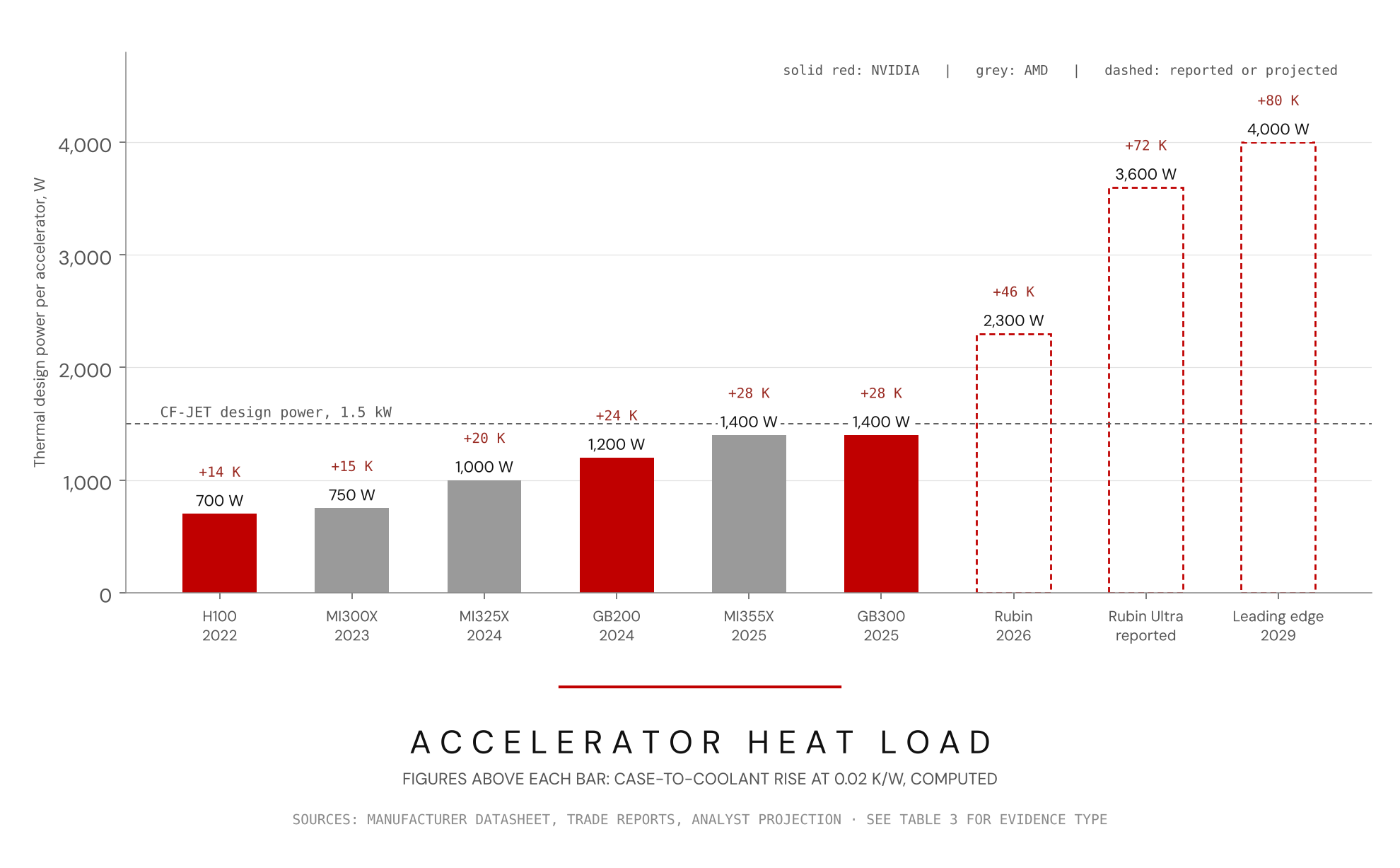
Drawn from Table 3. The dashed line marks the 1.5 kW CF-JET design power. Reported and projected values are marked in the figure.
Between 2022 and 2026 the reported value rises 3.3-fold, a computed growth rate of 34.6 percent a year. Extending to the 4,000 W projection for 2029 gives a 5.7-fold rise from 2022 at 28.3 percent a year (computed). An AMD executive cited in a trade report expected 1,600 W in 2026 to 2027 and 2,000 W in the years after 2027, a lower path than the NVIDIA values.81 The sources therefore agree on direction and differ on level, and every value after 2025 is a report or a projection.
3.2 At 0.02 K/W the coolant-to-case rise reaches 46 K at 2,300 W and 80 K at 4,000 W, and plate area must grow with power
The CF-JET design point gives a 30 K rise at 1.5 kW. The same resistance applied to accelerator powers gives 14 K for the H100, 28 K for the MI355X, 46 K for Rubin and 80 K for the 2029 projection (computed, Table 3). With the 65 °C inlet of the design point, the 2,300 W case would reach 111 °C and the 4,000 W case 145 °C at the cold plate (computed). No retrieved source states case temperature limits for these accelerators, so the table identifies a size of rise and makes no claim about compliance. The brief for this paper includes high-bandwidth memory beside the processor, and no retrieved source quantifies the heat load of memory stacks, so the values in Table 3 describe the accelerator package as reported and leave memory as a separate gap.
Resistance also depends on area. At a fixed average flux of 41.7 W/cm², 2,300 W needs 55 cm², which is 1.53 times the 36 cm² CF-JET plate, and 4,000 W needs 96 cm², 2.67 times the plate (computed). Parts up to 1,400 W fit within the 36 cm² plate at the design flux, since the largest requirement among them is 0.93 times the plate. Scaling the design to larger areas would change its resistance and pressure drop, and the proposal values apply only to the 60 mm by 60 mm geometry.82
3.3 Heat flux separates the CF-JET design point from the highest reported claims and targets
Figure 4 sets the CF-JET plate-average flux of 41.7 W/cm² beside three values from other sources. A US patent states that a panel-type AESA radar dissipates about 5 W/cm² or less and that GaN monolithic microwave integrated circuits dissipate well over that level.83 A DOE-sponsored final report from Virginia Tech sets a design target for wide bandgap power modules of heat flux over 400 W/cm², a 200 °C junction temperature and a power density of at least 100 kW/L.84 CoolIT claims a single-phase cold plate over 300 W/cm².85 The vendor claim is 7.2 times, and the DOE target 9.6 times, the CF-JET average (computed).
Figure 4. Heat flux values reported by sources compared with the CF-JET plate average
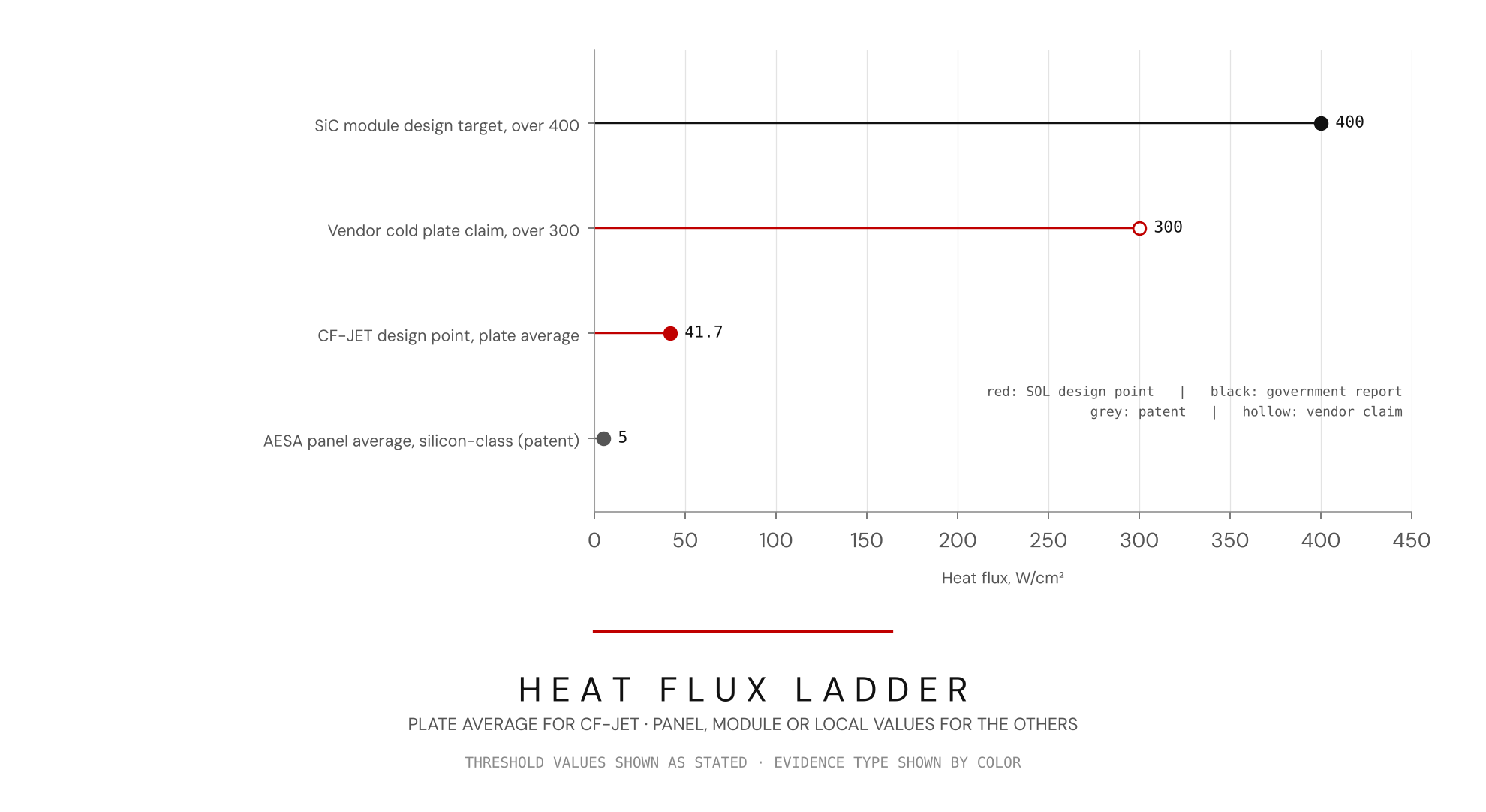
Values are as stated in each source. The CF-JET value is a plate average over 36 cm² and is derived from the design point; the others are panel averages, module targets or local values, which are not interchangeable with an average. Evidence type is shown by color.
The comparison has limits. An average over a 36 cm² plate and a local flux at a hot spot or a module target measure different things, and a jet-impingement plate is designed to place its highest transfer coefficients under the hottest region. NREL reports jet-impingement cooling of silicon carbide inverters with a heat transfer coefficient up to 93,000 W/m²K and a power density of 43 kW/L.86 The CF-JET design point corresponds to an effective conductance of 1.39 W/(cm²·K), or 13889 W/m²K, which is the plate-average flux divided by the 30 K rise (computed). The two quantities have different definitions, and the NREL value is 6.7 times the CF-JET effective conductance (computed), which indicates headroom between the design point and reported jet-impingement coefficients, subject to the difference in definitions.
3.4 Vendors report 4,000 W single-phase and 4,500 W two-phase cooling, and no independent test of either was retrieved
CoolIT reports a single-phase cold plate for 4,000 W processors with a thermal resistance under 0.009 °C/W, a loop pressure of 8 PSI and a flux over 300 W/cm², and states that the assumed single-phase limit before this design was 1,500 to 2,000 W.87 At 4,000 W, 0.009 °C/W gives a 36 K rise, and the CF-JET resistance of 0.02 K/W gives 80 K (computed). The 8 PSI pressure corresponds to about 55 kPa (computed), against the 30 kPa CF-JET target. Accelsius reports two-phase cooling of a thermal test vehicle at 4,500 W, and the test ended when it reached the power limit of the test infrastructure.88
Both claims are vendor material. An industry cold plate test specification published by the Open Compute Project defines resistance as (Ts − Tl) / P, requires six or more flow rates between 25 and 150 percent of rated flow for pressure drop and sets a reference fluid temperature of 45 °C, which differs from the 65 °C inlet of the CF-JET design point.89 Until vendor claims are reported under a common definition of case temperature, interface and fluid temperature, a resistance of 0.009 °C/W and one of 0.02 K/W are not comparable beyond the order of magnitude.
3.5 Reported cooling cost per rack is about $50,000 and rises 11.7 percent from the GB300 NVL72 to the Vera Rubin NVL144 (computed)
An investment bank estimate relayed by Tom’s Hardware puts the cooling system of a GB300 NVL72 rack at $49,860 and that of a Vera Rubin NVL144 rack at $55,710.90 The GB300 value is $692.5 per GPU position (computed, 72 positions). The report states an increase of 17 percent, while the two totals give 11.7 percent (computed). The per-tray figures reconcile more closely: a compute tray rises from about $2,260 to $2,660, which is 17.7 percent (computed), and 18 compute trays at $2,660 plus switch trays totaling $7,830 per rack sum to the $55,710 total (computed).91
Rack power gives the context. The GB200 NVL72 is a 120 kW rack, which is 1.67 kW per GPU position when all rack power is divided by 72 positions (computed).92 Rack power for the GB300 and Rubin racks appeared only in sources that were not verified for this paper, so those values are not used here. The retrieved evidence gives a cooling bill of materials near $50,000 per rack. The estimate relays an investment bank analysis, it describes the value of the cooling hardware at present, and no breakdown of the total beyond compute and switch trays was retrieved, so it gives no cold plate share.
4. Military and Commercial Applications
4.1 Army vehicle microgrids supply 100 kW per vehicle and set the largest quantified military power-electronics load
The Army vehicle-centric microgrid generates 100 kW per vehicle, conforms to the Tactical Microgrid Standard so that vehicles can share power, and is intended to supply future directed-energy and missile defense systems on the move.93 The Secure Tactical Advanced Mobile Power joint capability technology demonstration, led by GVSC and the DEVCOM C5ISR Center, builds a mobile microgrid on a high-power variant of the Family of Medium Tactical Vehicles, and two such vehicles produce roughly the power consumption of a maneuver division tactical operations center.94 A customer test of the 120 kW Advanced Medium Power Source microgrid at Fort Liberty on 19 to 21 March 2024 replaced the 100 kW generators of a field hospital.95
These are power levels, and the heat load follows from conversion losses that no retrieved source reports. At an assumed 97 percent conversion efficiency, 100 kW of output corresponds to about 3.1 kW of loss (computed, assumed), which is twice the 1.5 kW CF-JET design power. The assumption is illustrative, and the retrieved sources give no efficiency, no coolant temperature and no thermal requirement for any of these systems. Table 4 therefore records the load as not assessable until a thermal budget by component is obtained from the program office.
4.2 A 100 kW class laser consumes about 300 kW by one trade report, which implies a thermal load near 200 kW (derived)
DE M-SHORAD is a 50 kW class laser weapon on a Stryker vehicle.96 A trade article states that a 100 kW class directed-energy weapon consumes about 300 kW, and the retrieved listing truncates the sentence.97 If the difference between input and optical output is rejected as heat, the thermal load is near 200 kW, which equals 133 CF-JET plates at design power (derived, with the assumption stated). The heat is produced in several components, including laser diodes, power conversion and beam control, and the share located on electronic devices that a cold plate can reach was not retrieved. The relevant question for CF-JET is the component-level thermal budget, and no source in the retrieved material answers it.
4.3 Radar electronics are limited by an 80 °C module temperature, and the CF-JET design point reaches 95 °C at the case
A peer reviewed study of cooling for AESA radar states that the transmit/receive module temperature should stay under 80 °C to guarantee radar performance.98 A US patent describes panel-type AESA radar at about 5 W/cm² or less and GaN monolithic microwave integrated circuits well over that level.99 The panel average is under the CF-JET plate average of 41.7 W/cm², and the GaN device flux is over it. The CF-JET design point has a 65 °C inlet and a 30 K rise, so the case reaches 95 °C at 1.5 kW, which is over the 80 °C module limit (computed). A coolant inlet of 50 °C or lower would meet the limit at full load, before any resistance between the module and the case is counted (computed).
4.4 A Navy SBIR precedent moved a cold plate vendor’s cooling card into a tactical terminal during Phase II, with $2 million in orders
The Navy SBIR and STTR program office reports that ACT developed a high-conductivity cooling card under SBIR topic N172-137 for tactical link electronics.100 In Phase I, ACT worked with Data Link Solutions and Viasat, the primes for the MIDS-JTRS terminal, to identify thermal bottlenecks. ACT built prototypes for both primes, held monthly meetings with Navy and prime partners during development, and the primes qualified the card and selected it for the terminal. The report states manufacturing orders worth $2 million and gives no unit count.
The precedent shows three features that a cold plate transition can reproduce: a named prime contractor with a thermal problem, prototypes delivered to that prime during the award, and qualification by the prime before the award ended. It also has limits. The source is a program office article about a vendor, the product is a cooling card for avionics-class electronics, and the report makes no link to ground vehicle power conversion.
4.5 EV traction inverters have the best documented commercial flux targets, over 400 W/cm² at module level
A conference record from Oak Ridge National Laboratory describes a 100 kW segmented traction inverter with double-sided cooled silicon carbide modules and compact mini-channel heat sinks whose fin profile was optimized with genetic algorithms, and the retrieved page lists no numerical cooling results.101 The Virginia Tech report sets targets of heat flux over 400 W/cm², a 200 °C junction and at least 100 kW/L, and NREL reports jet-impingement cooling of silicon carbide inverters at up to 93,000 W/m²K and 43 kW/L.102103 Jet impingement is therefore an established approach in research inverters, and mini-channel heat sinks are a competing approach in the same application. The retrieved sources give no cost, mass or reliability comparison between the two.
4.6 No quantified sources were retrieved for unmanned aircraft, renewable inverters, rail and marine electrification or industrial lasers
Searches for unmanned aircraft, expeditionary inverter, renewable inverter, rail, marine and industrial laser cold plate loads returned no source with a heat load, flux or coolant temperature that could be cited here. Table 4 records each as not assessable. Closing the gap requires either a customer thermal specification or a measurement on a representative product, and the CF-JET test vehicle could supply the second if a design partner is identified.
Table 4. Use cases, quantified figures retrieved and fit with the CF-JET design point
| Use | Quantified figure retrieved | Limit stated | Fit with the CF-JET design point (assessment) | Evidence type |
|---|---|---|---|---|
| Ground vehicle power electronics and microgrids | Vehicle microgrid at 100 kW per vehicle with a Tactical Microgrid Standard; STAMP built on a high-power FMTV variant | No limit stated | Device loss was not retrieved; at an assumed 97 percent efficiency, 100 kW of output corresponds to about 3.1 kW of loss (computed) | Government news articles104105 |
| Directed energy | 50 kW class laser on a Stryker; a 100 kW class weapon consumes about 300 kW | No limit stated | Thermal budget by component needed; about 200 kW if all non-optical input is rejected as heat (derived) | Government article; trade press106107 |
| Radar and electronic warfare with GaN | Panel AESA about 5 W/cm² or less; GaN circuits well over that level | Transmit/receive module under 80 °C | Design point gives 95 °C at the case, which is over the limit; a 50 °C inlet meets it at 1.5 kW (computed, module-to-case resistance excluded) | Patent; peer reviewed paper108109 |
| Aviation and unmanned aircraft | No quantified source retrieved | Not retrieved | Not assessable | Gap |
| Expeditionary microgrids | AMMPS 120 kW microgrid tested at Fort Liberty, 19 to 21 March 2024 | No limit stated | As for ground vehicles; loss and coolant temperature not retrieved | Government news article110 |
| EV traction inverters | Design target over 400 W/cm², 200 °C junction, at least 100 kW/L; jet-impingement coefficient up to 93,000 W/m²K | 200 °C junction (target) | Module-level target is 9.6 times the plate average (computed) | Government-sponsored report; laboratory feature111112 |
| Data center accelerators | 1,400 to 2,300 W per GPU (reported) | Not retrieved | Plate area multiples 0.93 to 1.53 of the 36 cm² plate (computed, Table 3) | Trade press; analyst projection113 |
| Renewable inverters, rail and marine electrification, industrial lasers | No quantified source retrieved | Not retrieved | Not assessable | Gap |
The fit column is an assessment computed or interpreted from the CF-JET design point of 1.5 kW, 65 °C inlet, 30 K rise and 41.7 W/cm². The 97 percent efficiency is an assumption. Loss at 100 kW is output multiplied by 0.03 and divided by 0.97. Rows marked as gaps record that no sourced figure was retrieved.
5. Transition Pathways from ARL Research to GVSC, Program Offices, and SBIR/STTR
5.1 ARL moves technology through cooperative agreements and licenses, and it may receive funds under an agreement but cannot send funds to the partner
ARL Open Campus is a program for collaboration among ARL researchers, academia, industry and small businesses, and its tools include cooperative agreements, educational partnership agreements and cooperative research and development agreements (CRADAs).114 Under a CRADA the government contributes personnel, facilities, equipment or other resources, and ARL may receive financial contributions from the partner and cannot send funds to it. ARL proposed 48 CRADAs in fiscal year 2014, up from 19 in 2013, of which 21 were with academic partners and 27 with industry, and many were still in staffing and approval. No more recent count was retrieved.
The ARL Partnership Support Office handles commercial evaluation licenses, patent license agreements and CRADAs.115 ARL granted CloudSci a patent license agreement for a passive aerosol imager after the company first received a commercial evaluation license, and an ARL technology transfer specialist is quoted that an evaluation license can be valuable for a small business that needs time to test market viability. For CF-JET, a CRADA with a university co-investigator or an industry partner moves work without funding it, and the funded path is the set of awards in Table 5.
5.2 SBIR and STTR ceilings differ by year and solicitation, and the SBA guideline for Phase II is now $2.24 million
GVSC reported in February 2020 that Phase I awards were normally up to $167,500 over about six months, Phase II awards usually capped at $1.1 million over two years, and Rapid Innovation Fund contracts were limited to $3 million and typically lasted up to two years.116 The SBIR.gov Army tutorial states a Phase II ceiling of $1.1 million as of March 2021 and a Phase II Enhancement of up to $550,000.117118 The Army Applied SBIR program stated Phase I awards of up to $250,000 in December 2022 and Direct to Phase II awards of up to $1.7 million in October 2022.119120 The SBA guideline effective 16 October 2026 is $335,937 for Phase I and $2,239,578 for Phase II, and agencies exceed those levels only with a waiver.121
Table 5. Funding and transition vehicles from ARL research to production
| Vehicle | Stated ceiling and duration | Condition | Evidence type |
|---|---|---|---|
| ARL cooperative research and development agreement | ARL may receive funds and cannot send funds to the partner; 48 agreements proposed in fiscal year 2014, 21 academic and 27 industry | Government contributes personnel, facilities or equipment under a formal agreement | Government news article122 |
| ARL commercial evaluation license and patent license agreement | No amounts retrieved | Handled by the ARL Partnership Support Office; an evaluation license can give a small business time to test market viability | Government news article123 |
| SBIR Phase I, GVSC (2020) | Normally up to $167,500 over about six months | Small business award | Government news article124 |
| SBIR Phase I, Army Applied SBIR (2022) | Up to $250,000 | Stated for one 2022 selection | Government news article125 |
| SBIR Phase II, Army | Up to $1.1 million over two years (2020, and as of March 2021) | Builds on Phase I work | Government news article; government page126127 |
| SBIR Phase II Enhancement | Up to $550,000 | Army tutorial document | Government training document128 |
| Direct to Phase II (2022) | Up to $1.7 million each | For more mature solutions ready for demonstration | Government news article129 |
| SBA award guideline, effective 16 October 2026 | Phase I $335,937; Phase II $2,239,578 | Agencies exceed these levels only with a waiver | Government page130 |
| GVSC Rapid Innovation Fund (2020) | Typically up to two years and up to $3 million | Negotiated after initial selection | Government news article131 |
| Army SBIR CATALYST pilot (2023) | Base up to $1 million over 6 to 12 months; Phase II Enhancement up to $7 million SBIR, $3.5 million transition partner and $3.5 million integrator over 12 to 24 months; up to $15 million per business | Pairs a small business with a transition partner and an integrator | Government news article132 |
| Strategic Breakthrough Award (2026) | Up to $30 million over 48 months | Agencies with SBIR budgets over $100 million; technology in a program objective memorandum; 1:1 match with at least 20 percent from new funding outside SBIR/STTR; prior Phase II award | Program office newsletter; no Army solicitation retrieved133 |
| SBIR Phase III, sole source | No ceiling retrieved | GAO held that one SBIR-derived component can support a sole-source award when reasonably related to the system objective | Law firm commentary on a GAO decision134 |
Amounts are as stated in each source for the year shown and differ by solicitation. The Strategic Breakthrough Award is described in a Navy newsletter, and no retrieved source states that the Army offers it. The Phase III row is law firm commentary on a GAO decision, and the decision text was not retrieved.
Figure 5. Stated award ceilings for small business and Army vehicles
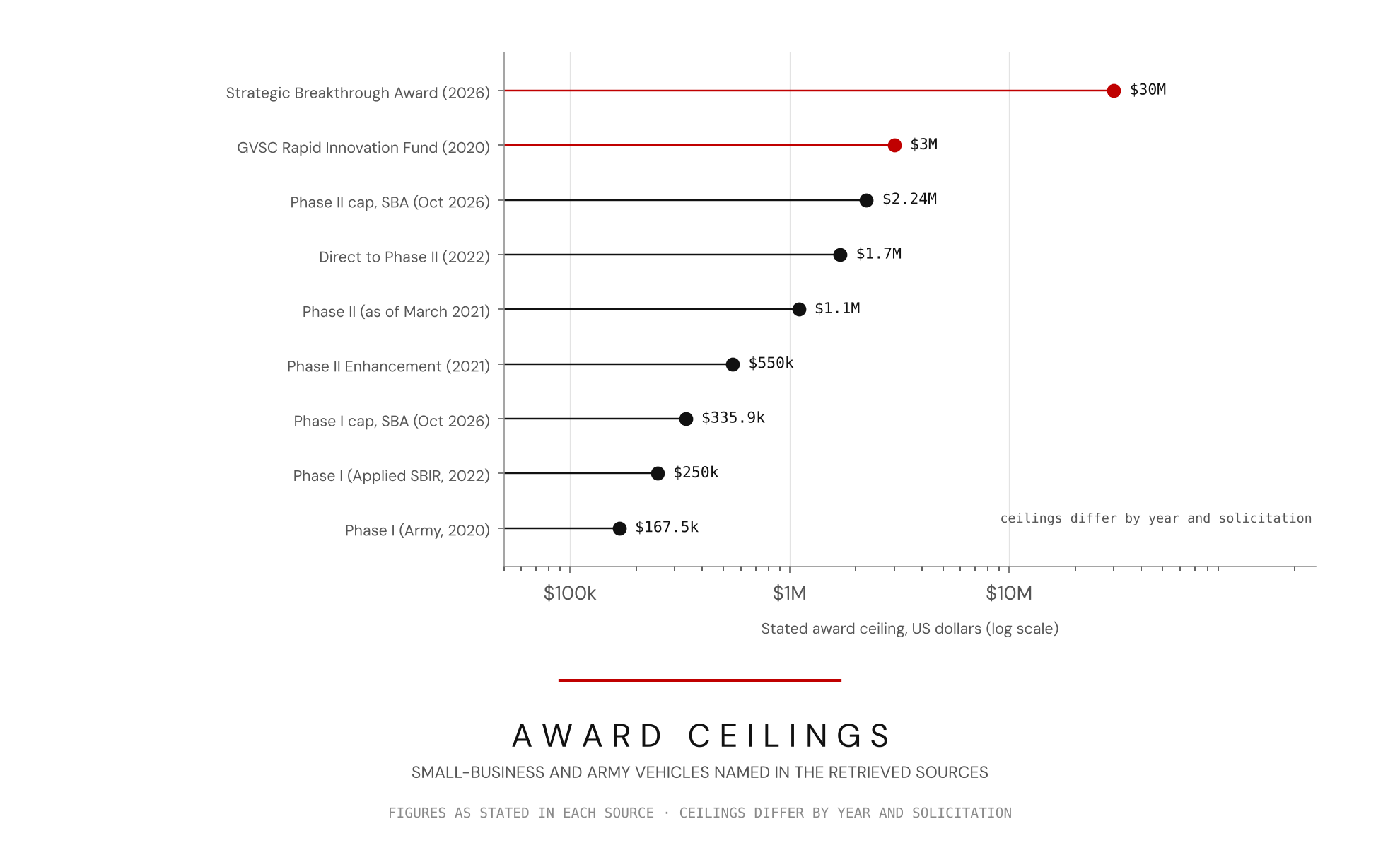
Drawn from Table 5. Ceilings differ by year and solicitation. The SBA guideline for Phase II in 2026 is about twice the 2020 and 2021 Army Phase II ceiling of $1.1 million (computed).
The SBA Phase I guideline of $335,937 is 2.0 times the 2020 GVSC Phase I figure, and the Phase II guideline of $2,239,578 is 2.0 times the 2020 and 2021 Army Phase II figure (computed). A proposal budget should therefore cite the ceiling stated in the specific topic. The dollar ceilings determine the scale of work each award can support: an award near $2.24 million funds a prototype build and a test campaign, and a figure of $167,500 funds a feasibility study.
5.3 CATALYST and Strategic Breakthrough Awards fund the stage after Phase II at up to $15 million and up to $30 million
The Army SBIR CATALYST pilot, announced in May 2023, offers five small businesses base contracts of up to $1 million over 6 to 12 months and a Phase II Enhancement of up to $7 million in Army SBIR funds, up to $3.5 million from an Army transition partner and up to $3.5 million from a technology integrator over 12 to 24 months, a 2:1:1 ratio.135 The total is up to $15 million per business and up to $75 million across the five. The SBIR share of the Enhancement is 50 percent of $14 million (computed), and the remainder must come from a program and an integrator.
A Navy newsletter describes Strategic Breakthrough Awards of up to $30 million over 48 months, available from agencies with SBIR budgets over $100 million, for technology in a program objective memorandum that addresses high-priority military requirements, with 1:1 matching of which at least 20 percent comes from new funding outside SBIR and STTR and with a prior Phase II award required.136 The $30 million ceiling is 13.4 times the SBA Phase II guideline (computed). No Army solicitation for this award was retrieved, so its availability to GVSC topics is unconfirmed. Both mechanisms require a program office or integrator that commits money, and neither is available to a technology without a customer.
5.4 GAO has held that one SBIR-derived component can support a sole-source Phase III, and no retrieved source addresses work that began under a BAA
In Digital Force Technologies, GAO decision B-423319 of 19 May 2025, GAO denied a protest of a sole-source Phase III solicitation issued by the Air Force to Clear Align and found no rule barring Phase III authority when only one component of a system derives from prior SBIR work, provided the component is reasonably related to the system objective.137 A cold plate is a component of a power conversion or radar system, so the decision supports a Phase III award to a cold plate supplier whose product traces to an SBIR Phase II. The source is law firm commentary, the decision text was not retrieved, and the commentary is not legal advice.
Phase III follows from prior SBIR or STTR work, and a technology developed under a foundational research BAA has no such prior work. No retrieved source states whether BAA-funded research can feed a Phase III award. The assessment here is that CF-JET needs an SBIR or STTR award, such as a GVSC Phase I or a Direct to Phase II, to create the Phase III link, and the question goes to the contracting officer. Small business eligibility for those awards depends on ownership and size and is a matter to confirm.
A staged sequence gives the scale of the funding path. Using the SBA guidelines, a Phase I of $335,937 and a Phase II of $2,239,578 sum to $2,575,515 (computed), and the durations stated by GVSC, about six months and two years, give about 30 months from Phase I start to Phase II end (computed). A CATALYST award would add up to $15 million over durations of 6 to 12 months and 12 to 24 months if a transition partner and an integrator commit matching funds. These are ceilings, and the awards depend on topics, selections and program commitments that no source forecasts.
The sources support a gated sequence for CF-JET, offered here as an assessment. The first gate is documented validation evidence for the plate under a stated test definition. The second is a component-level thermal budget from a GVSC or C5ISR program. The third is an SBIR or STTR topic or a Direct to Phase II selection that creates prior SBIR work. The fourth is qualification by a named prime or integrator, as in the ACT precedent, and the fifth is a Phase III, program-office or licensing agreement. Each gate has a cost and a duration in Table 5 and the cited sources, and none can be shortened by a CRADA alone.
5.5 GVSC and C5ISR demonstrations show the program-office route, and no retrieved source names a cold plate requirement within them
The STAMP demonstration is credited to GVSC and the C5ISR Center, both subordinate to DEVCOM, and it moved a mobile microgrid from design to demonstration on a tactical vehicle.138 The vehicle microgrid program uses a standard that lets compliant systems exchange power.139 The AMMPS test is a customer test of a fielded microgrid candidate at a field hospital.140 These programs are the likely customers for vehicle power electronics, and a cold plate would enter as a component of a power conversion assembly purchased by the program or its integrator. No retrieved source names a thermal management requirement, a coolant temperature or a cold plate in any of the three programs.
6. Licensing Models for AI Engineering Design Toolkits
6.1 Engineering software uses five established licensing models, and no retrieved source gives prices for AI toolkits
Table 6 lists the models documented in the retrieved sources. A 2019 trade article reports that one vendor still offered perpetual licenses with maintenance while defaulting new software to subscription, that another sold only by subscription and software as a service, and that Ansys offered perpetual licenses, subscriptions and Elastic Licensing together.141 Ansys Elastic Units are bought in predetermined packages and managed over the internet without a local license manager.142 Siemens Simcenter X tokens are checked out while a job uses a solver and returned when it ends, can be assigned to individuals or teams, and pair with named-user seats.143 NVIDIA released its physics machine learning platform PhysicsNeMo as open source under Apache 2.0 in 2023.144
Table 6. Licensing models for engineering software and toolkits
| Model | Mechanism | Example | Evidence type |
|---|---|---|---|
| Perpetual license with maintenance | Customer buys the software once and pays for maintenance; one vendor still offered it in 2019 and another kept it because customers want to own software | Siemens, Alibre (2019) | Trade press145 |
| Subscription | Time-limited access; one vendor defaults new software to subscription, another sells only by subscription and SaaS | Siemens, Autodesk, PTC (2019) | Trade press146 |
| Pay-per-use units | Prepaid units consumed by core hours and solver type, bought in predetermined packages, with access across the portfolio managed over the internet | Ansys Elastic Licensing | Trade press147148 |
| Checked-out tokens | Tokens are checked out while a solver or feature is in use and returned when the job ends; assignable to individuals or teams and paired with named-user seats | Siemens Simcenter X tokens; Autodesk Token Flex (2019) | Vendor material; trade press149150 |
| Open source | Source released under Apache 2.0, free to use and modify | NVIDIA PhysicsNeMo (2023) | Vendor material151 |
| Laboratory evaluation license, then patent license | A commercial evaluation license gives time to test an invention before a patent license agreement | ARL and CloudSci (2025) | Government news article152 |
Offerings are as reported in the cited sources and the trade articles date from 2019, so current terms may differ. No source retrieved for this paper states prices for any of these models or any standard governing AI toolkit licensing.
The retrieved material contains no standards document, no government source and no price data on licensing of AI engineering toolkits. Evidence is limited to trade articles from 2019 and vendor pages, which describe mechanisms and leave out prices, discounts, renewal rates and the share of customers on each model. Any price in a proposal would therefore be an assumption.
6.2 A toolkit that sweeps conditions in code and trains surrogates fits unit-based and token models, with subscription for stored data (assessment)
The discussion here is an assessment of mechanics and makes no statement about SOL’s plans. The SOL Aquifer description includes scripted condition sweeps, physics solvers in code, a database with provenance and surrogate training with uncertainty quantification.153 Condition sweeps and surrogate training consume compute in proportion to the number of cases, which resembles the core-hour and solver-type consumption of pay-per-use units. Access to solvers and trained surrogates by teams across institutions resembles the checkout and return of tokens, and a university co-investigator network could share a pool. The stored database of coupon, single-jet and prototype results grows with use and fits a subscription.
A laboratory evaluation license is the model closest to the early use of an invention by a partner, and ARL’s sequence of an evaluation license followed by a patent license agreement is the retrieved example.154 The mapping depends on how SOL meters usage, and no retrieved source gives the unit cost of a condition sweep or a surrogate training job.
6.3 An open-source framework at Apache 2.0 sets a free reference, so paid value for a thermal toolkit lies in validated data and support (assessment)
PhysicsNeMo is available free under Apache 2.0, so a physics machine learning framework has a zero-price substitute in the market for general model development.155 A thermal toolkit for cold plates differs in what it contains: codified conditions, solvers set up for the geometry, surrogates trained on calibrated hardware data and a provenance record. The assessment is that a paid offering competes on validated data, uncertainty statements and support, and an open-source core with paid data and validation services is one of the structures consistent with the models in Table 6. The retrieved sources do not report revenue from any open-core engineering software offering.
7. Implications for the CF-JET Effort
7.1 Risks
Market size estimates for liquid cooling differ 5.7-fold in 2024 by scope, so a planning figure without a stated scope can mislead a reader about opportunity.
Reported accelerator power reaches 2,300 W, and the CF-JET resistance of 0.02 K/W gives a 46 K rise at that power, which cannot be compared with the 30 K design rise without area scaling.
The design point gives a 95 °C case at full load, over the 80 °C limit stated for AESA transmit/receive modules, so radar use requires a lower inlet temperature.
Vendor claims of 4,000 W single-phase and 4,500 W two-phase cooling set a performance reference that no independent test supports, and buyers may cite them.
Cold plate suppliers are being absorbed by large infrastructure groups, which control channels to the largest customers.
Phase III and the Strategic Breakthrough Award both depend on prior SBIR work, a prior Phase II or a matched program commitment, and no retrieved source shows that BAA-funded work qualifies.
No retrieved source gives prices for AI toolkit licensing, so any licensing revenue estimate rests on assumptions.
7.2 Design implications
Report resistance as (Ts − Tl) / P with six or more flow rates and also at the 45 °C reference fluid of the industry specification, alongside the 65 °C design inlet, so that results can be compared with vendor claims.156
Define a configuration for accelerator-class power: 55 cm² is the plate area at 41.7 W/cm² for 2,300 W (computed), so a family of plate areas would cover 700 to 2,300 W.
Offer a lower-inlet configuration for radar: a 50 °C inlet meets the 80 °C limit at 1.5 kW before module-to-case resistance is counted (computed).
Obtain component-level thermal budgets from GVSC and C5ISR programs for vehicle power electronics and directed energy before sizing a demonstration.
Structure a Phase II-type effort as ACT did, with a named prime, prototypes delivered during the award and qualification by the prime.157
Meter toolkit usage by condition sweep and surrogate training job so that unit-based and token licensing can be applied.
7.3 Open research questions
What heat loads by component do GVSC vehicle microgrid power electronics and directed-energy systems present, and at what coolant temperatures?
What case temperature limits apply to current and upcoming accelerators, and do they permit a 65 °C inlet?
Can research funded under a foundational BAA feed an SBIR Phase III award, and which Army topics fit the CF-JET plate?
What independent test results exist for vendor claims of 4,000 W single-phase and 4,500 W two-phase cooling?
What cold plate heat loads and temperatures apply to unmanned aircraft, renewable inverters, rail, marine electrification and industrial lasers?
What prices do customers pay for AI engineering toolkit licenses under unit, token and subscription models?
8. Conclusion
The commercial market for liquid cold plates is large and poorly measured: 2024 estimates differ 5.7-fold by scope, two sources put cold plates near $0.3 billion, and three suppliers changed hands for $15.1 billion in stated prices. Accelerator power has risen from 700 W to a reported 2,300 W in four years and is projected over 4,000 W by 2029, and a resistance of 0.02 K/W would produce coolant-to-case rises of 46 K at the reported 2026 value and 80 K at the 2029 projection (computed). Vendor claims of 0.009 °C/W and of 4,500 W cooling exceed the CF-JET design point and lack independent tests.
The military entry depends on thermal budgets that the retrieved sources do not report, and the radar limit of 80 °C already identifies a coolant inlet requirement of 50 °C or lower at 1.5 kW. Transition funding spans $167,500 to $30 million by vehicle and year, and the larger vehicles require a program or integrator that commits funds and, for Phase III, prior SBIR work. Licensing models for engineering software are established, and no retrieved source prices an AI toolkit. The questions that most change the plan are the component-level thermal budgets at GVSC, the accelerator case temperature limits and the eligibility of BAA-funded work for Phase III.
Bibliography
360iResearch. Data Center Liquid Cooling Market. April 2025 edition. Listing at Global Information, Inc., accessed 27 November 2026. https://www.giiresearch.com/report/ires1714672-data-center-liquid-cooling-market-by-component.html. Commercial analyst report; summary figures only.
360iResearch. “$5.47 Bn Data Center Liquid Cooling Markets Global Forecast 2025–2030.” GlobeNewswire, 29 August 2025. https://www.globenewswire.com/news-release/2025/08/29/3141503/0/en/5-47-Bn-Data-Center-Liquid-Cooling-Markets-Global-Forecast-2025-2030-A-Deep-Dive-into-Efficiency-and-Sustainability-Trends.html. Analyst report press release (commercial).
ABI Research. “Data Center Liquid Cooling Market Size.” Chart data page, accessed 27 November 2026. https://abiresearch.com/news-resources/chart-data/data-center-liquid-cooling-market-size. Commercial analyst report; summary figures only.
Accelsius. Press release on thermal milestones for next-generation AI computing. Silicon UK, April 2025. https://www.silicon.co.uk/press-release/accelsius-achieves-industry-leading-thermal-milestones-for-next-generation-ai-computing. Vendor press release; test claims not verified by independent testing.
Reisch, Jennifer. “ACT Transitions Cooling Technology during SBIR Phase II.” Navy SBIR/STTR Program success story, May 2022. https://www.navysbir.com/success/docs/SPT-ACT-22.pdf. Program office document describing a vendor; the order value is as stated by the program office.
Rodriguez, Eitter. “US Army Conducts Test of Advanced Medium Power Source Microgrid System.” Army.mil, 18 April 2024. https://www.army.mil/article/275435/us_army_conducts_test_of_advanced_medium_power_source_microgrid_system. Government news article.
DE Editors. “ANSYS Boosts Support for On-Premise Simulation through Elastic Licensing.” Digital Engineering, 7 October 2019. https://www.digitalengineering247.com/article/ansys-boosts-support-for-on-premise-simulation-through-elastic-licensing. Trade press; a 2019 article describing the program as announced.
Arizton. “Data Center Liquid Cooling Market.” Market report summary page, accessed 27 November 2026. https://www.arizton.com/market-reports/data-center-liquid-cooling-market. Commercial analyst report; summary figures only, full report not reviewed; the estimate counts investment.
Brady, Jenna. “Open Campus Initiative Allows Open Collaboration for Army Research Laboratory.” ARL Public Affairs, 5 September 2014. https://www.army.mil/article/133081/. Government news article; the CRADA counts are for fiscal years 2013 and 2014.
U.S. Army DEVCOM Army Research Laboratory Public Affairs. “Army Scientists Transition Innovations into Transformative Technology Patents.” 18 August 2025. https://www.army.mil/article/287884/. Government news article.
U.S. Army DEVCOM Army Research Laboratory. “Artificial Intelligence and Machine Learning with Extremely Sparse Data (ARL-BAA-0038).” In Current Research Topics for DEVCOM ARL BAA for Foundational Research, 9 December 2024. https://files.simpler.grants.gov/opportunities/5e185327-5f25-4c09-889a-43615e1f54da/attachments/e4621f8a-b19c-40ec-8c59-6611cc4fa276/Current_Research_Topics_for_DEVCOM_ARL_BAA_9_Dec2024.pdf.
Danfelt, Karen. “Army Awards Small Businesses for Innovation in AI, Machine Learning, Sensors and Clean Technologies.” Office of Army Prize Competitions and Army Applied SBIR Program, 31 October 2022. https://www.army.mil/article/261608. Government news article.
Smoot, Daniel. “Army Awards Small Businesses for Innovation in Sensing and Materials Readiness.” Office of Army Prize Competitions and Army Applied SBIR Program, 2 December 2022. https://www.army.mil/article-amp/262465/army_awards_small_businesses_for_innovation_in_sensing_and_materials_readiness. Government news article; the categories in the article are internally inconsistent, and the $250,000 figure is as stated in its text.
Smoot, Daniel. “Army SBIR CATALYST Pilot Offers Five Businesses up to $75M.” Office of Army Prize Competitions and Army Applied SBIR Program, 9 May 2023. https://www.army.mil/article/266544/army_sbir_catalyst_pilot_offers_five_businesses_up_to_75m. Government news article.
Vergun, David. “DOD Demonstrates Mobile Microgrid Technology.” DOD News, 6 July 2021. https://www.army.mil/article/248221/dod_demonstrates_mobile_microgrid_technology. Government news article.
CoolIT Systems. “CoolIT Systems 4000W Breakthrough: Redefining Single-Phase DLC for Ultra-High Wattage AI Processors.” News release, accessed 27 November 2026. https://www.coolitsystems.com/resources/news/coolit-systems-4000w-breakthrough-redefining-single-phase-dlc-for-ultra-high-wattage-ai-processors/. Vendor material; test claims not verified by independent testing.
Freling, Scott A., and Peter Terenzio. “Digital Force Technologies, Inc.: A ‘SBIR-Derived Component’ Can Be Sufficient for SBIR Phase III.” Covington & Burling LLP blog, 4 June 2025. https://www.covingtonblogs.com/2025/06/04/digital-force-technologies-inc-a-sbir-derived-component-can-be-sufficient-for-sbir-phase-iii/. Law firm commentary on GAO decision B-423319 (19 May 2025); the decision text was not retrieved, and the commentary is not legal advice.
Skelley, Katie Davis. “Directed Energy Weapon System Points toward the Future of Warfare.” DEVCOM Aviation & Missile Center Public Affairs, 26 September 2022. https://www.army.mil/article/260538/. Government news article.
Dell’Oro Group. “AI Build-Out to Propel Data Center Physical Infrastructure Market to $63.1 Billion by 2029.” Press release, August 2025. https://www.delloro.com/news/ai-build-out-to-propel-data-center-physical-infrastructure-market-to-63-1-billion-by-2029/. Analyst press release (commercial).
Dell’Oro Group. “Data Center Liquid Cooling Market to Approach $7 Billion by 2029 as AI Deployments Accelerate.” Press release, 8 January 2026. https://www.delloro.com/newsroom/data-center-liquid-cooling-market-to-approach-7-billion-by-2029-as-ai-deployments-accelerate/. Analyst press release (commercial); the estimate counts manufacturer revenue.
Eaton. Press release announcing the agreement to acquire Boyd Thermal. Business Wire, 3 November 2025. https://www.businesswire.com/news/home/20251103856036/en. Company press release; the 2026 sales and multiple are company forecasts.
Ecolab Inc. “Ecolab to Acquire CoolIT Systems, a Global Leader in Advanced Liquid Cooling for Next-Gen AI Data Centers.” Form 8-K, Exhibit 99.1, 20 March 2026. https://www.sec.gov/Archives/edgar/data/31462/000110465926032446/tm269446d1_ex99-1.htm. Company filing; the sales figure is a company forecast.
“Ecolab Closes CoolIT Acquisition and Expands AI Cooling Platform as Global High Tech Business Targets $4 Billion by 2030.” ISSA industry news, accessed 27 November 2026. https://www.issa.com/?p=72213. Trade association news item; the closing date is not stated in the retrieved text.
Fortune Business Insights. “Data Center Liquid Cooling Market.” Market report summary page, accessed 27 November 2026. https://www.fortunebusinessinsights.com/data-center-liquid-market-116182. Commercial analyst report; summary figures only.
Global Industry Analysts. Cold Plate. Report listing at MarketResearch.com, accessed 27 November 2026. https://www.marketresearch.com/Global-Industry-Analysts-v1039/Cold-Plate-40889639. Commercial analyst report; summary figures only; the scope is cold plates across all applications.
Halleaux, Douglas. “U.S. Army Announces Small Business-Targeted Contract Awards for Ground Vehicle Technologies.” GVSC, 10 February 2020. https://www.army.mil/article/232565/us_army_announces_small_business_targeted_contract_awards_for_ground_vehicle_technologies. Government news article; amounts are as stated for that solicitation.
MarketsandMarkets. “Data Center Liquid Cooling Market.” Market report summary page, accessed 27 November 2026. https://marketsandmarkets.com/Market-Reports/data-center-liquid-cooling-market-84374345.html. Commercial analyst report; summary figures only.
Department of the Navy SBIR/STTR Program. Transitions Newsletter, 2026 Spring Edition. “From the Director: SBIR/STTR Programs Reauthorized.” 2026. https://navystp.com/wp-content/uploads/2026/04/Spring-2026-Transitions-Newsletter-final.pdf. Program office newsletter; the document describes Strategic Breakthrough Awards across agencies and is not an Army solicitation.
National Renewable Energy Laboratory. “Advanced Thermal Management Design Boosts Performance of Silicon Carbide Inverters for Heavy-Duty Vehicles.” Feature article, 2021. https://www.nrel.gov/news/features/2021/advanced-thermal-management-design-boosts-performance-of-silicon-carbide-inverters-for-heavy-duty-vehicles.html. Government laboratory feature.
NVIDIA. Blog post on the Blackwell platform and partner liquid cooling infrastructure. NVIDIA Blog, accessed 27 November 2026. https://blogs.nvidia.com/blog/blackwell-platform/. Vendor material; the headline is not reproduced.
Gadhia, Bhoomi, Ram Cherukuri, and Kristen Perez. “Physics-Informed Machine Learning Platform NVIDIA PhysicsNeMo Is Now Open Source.” NVIDIA Technical Blog, 23 March 2023. https://developer.nvidia.com/blog/physics-ml-platform-physicsnemo-is-now-open-source. Vendor material.
Sutton, Ben, Brad Zakaib, Gerald Singer, Ian Winfield, and Tyler Loughran. Single-Phase Direct-to-Chip Cold Plate Test Specification. Version 1.0.0. Open Compute Project, 11 August 2026. https://www.opencompute.org/wp-content/uploads/2026/10/OCP-Cold-Plate-Test-Specification-V1.0.0.pdf. Industry specification; the primary author and one co-author are affiliated with a cold plate manufacturer.
Park, Jun Su, Dong-Jun Shin, Sung-Hwan Yim, and Sang-Hyun Kim. “Evaluate the Cooling Performance of Transmit/Receive Module Cooling System in Active Electronically Scanned Array Radar.” Electronics 10, no. 9 (2021): 1044. https://www.mdpi.com/2079-9292/10/9/1044.
“High-Energy Lasers Advance Defense and More.” Photonics.com, accessed 27 November 2026. https://photonics.com/Articles/Related_High-Energy_Lasers_Advance_Defense_and/ar66762. Trade press; the headline is shortened in the retrieved listing.
“A Closer Look at Nvidia’s 120kW DGX GB200 NVL72 Rack System.” The Register, 21 March 2024. https://www.theregister.com/on-prem/2024/03/21/a-closer-look-at-nvidias-120kw-dgx-gb200-nvl72-rack-system/912087. Trade press.
The Register. Report on the NVIDIA H100 GPU. 22 March 2022. https://www.theregister.com/2022/03/22/nvidias_h100_gpu/. Trade press; the headline is not reproduced.
SBIR.gov. Army SBIR Tutorial. Dawnbreaker course document, accessed 27 November 2026. https://www.sbir.gov/sites/all/modules/custom/sbir_tutorials/dawnbreaker/img/documents/Course2-Tutorial1-ARMY.pdf. Government training document; the Phase II Enhancement ceiling of $550,000 is as stated there.
SBIR.gov. “Individual Agency Requirements: DOD Services.” Tutorial page, accessed 27 November 2026. https://www.sbir.gov/tutorials/individual-agency-requirements/DOD-services. Government page; the Army Phase II ceiling of $1.1 million is stated as of March 2021.
U.S. Small Business Administration. “About SBIR/STTR.” SBIR.gov, accessed 27 November 2026. https://www.sbir.gov/about. Government page; the retrieved page lists Phase I and Phase II award guidelines effective 16 October 2026.
“Infrastructure Giant Schneider Electric Powers Up with $850M Liquid Cooling Deal.” The Register, 17 October 2024. https://www.theregister.com/2024/10/17/schneider_850m_stake_motivair/. Trade press.
“A High-Power Density Segmented Traction Drive Inverter.” Conference paper record, OSTI ID 2267637. Oak Ridge National Laboratory. Accessed 27 November 2026. https://www.osti.gov/biblio/2267637. Government laboratory record; the retrieved page lists no authors or numerical cooling results.
SemiAnalysis. Newsletter post on accelerator power profiles. Accessed 27 November 2026. https://newsletter.semianalysis.com/i/188150420. Independent analyst newsletter; the figures are described as default power profiles.
Siemens. “Simcenter X Tokens.” Product page, accessed 27 November 2026. https://www.siemens.com/en-us/products/simcenter/simcenter-x/tokens/. Vendor material.
SOL Engineering Services, LLC. CF-JET: AI/ML-Enabled Design and Development of an Additively Manufactured, Liquid-Cooled Jet-Impingement Cold Plate with Optimized Carbon Fiber Target Plate. Proposal, Rev Final 2, n.d.
SOL Engineering Services, LLC. SOL Aquifer software pipeline diagram. n.d.
SOL Engineering Services, LLC. “Modeling HVAC System Performance: Code as Architecture Approach to AI.” Work carried out with Alabama A&M University students, n.d.
Stackpole, Beth. “New Licensing Options Satiate Users’ Appetite for Design Tool Flexibility.” Digital Engineering, 1 December 2019. https://digitalengineering247.com/article/new-licensing-options-satiate-users-appetite-for-design-tool-flexibility. Trade press; the offerings are as reported in 2019 and may differ.
McClenachan, Sean, Samuel Gwinn, and Joseph McFillin. “STAMP: Advanced Power Distribution as a Force Multiplier.” Army Sustainment, fall 2024. Published 17 October 2024. https://www.army.mil/article/280356. Government professional journal.
Technavio. “Liquid Cooling for AI Data Centers Market.” Report summary page, April 2026. https://www.technavio.com/report/liquid-cooling-for-ai-data-centers-market-industry-analysis. Commercial analyst report; summary figures only. The cold plate segment value is stated on the page.
TechRadar. Report on the cooling cost of a Blackwell Ultra NVL72 rack. Accessed 27 November 2026. https://www.techradar.com/pro/got-a-spare-usd50-000-cooling-a-single-nvidia-blackwell-ultra-nvl72-rack-costs-as-much-as-a-tesla-model-y-and-its-only-going-to-get-more-expensive-with-new-racks. Trade press.
“Nvidia’s Next-Gen B300 GPUs Have 1,400W TDP, Deliver 50% More AI Horsepower: Report.” Tom’s Hardware, accessed 27 November 2026. https://www.tomshardware.com/tech-industry/artificial-intelligence/nvidias-next-gen-b300-gpus-have-1-400w-tdp-deliver-50-percent-more-ai-horsepower-report. Trade press relaying an analyst report; not a manufacturer specification.
Tom’s Hardware. Report on the cooling system cost of an NVIDIA Blackwell Ultra NVL72 rack. Accessed 27 November 2026. https://www.tomshardware.com/pc-components/cooling/cooling-system-for-a-single-nvidia-blackwell-ultra-nvl72-rack-costs-a-staggering-usd50-000-set-to-increase-to-usd56-000-with-next-generation-nvl144-racks. Trade press relaying an investment bank estimate; the percentage stated by the report differs from the sum of the listed totals.
Tom’s Hardware. Report on the AMD MI300X power rating of 750 watts. Accessed 27 November 2026. https://www.tomshardware.com/news/amd-mi300x-guzzles-power-rated-for-750-watts. Trade press; the headline is not reproduced.
Tom’s Hardware. Report on the AMD Instinct MI350X and MI355X announcement. Accessed 27 November 2026. https://www.tomshardware.com/pc-components/gpus/amd-announces-mi350x-and-mi355x-ai-gpus-claims-up-to-4x-generational-gain-up-to-35x-faster-inference-performance. Trade press; the headline is not reproduced.
Tom’s Hardware. Report on the AMD Instinct MI355X power of 1,400 watts. Accessed 27 November 2026. https://www.tomshardware.com/pc-components/gpus/amds-instinct-mi355x-accelerator-will-consume-1-400-watts. Trade press; the headline is not reproduced. The report includes an AMD executive view and a reported Rubin Ultra figure.
Tom’s Hardware. Report on NVIDIA Vera Rubin power demand of 2,300 watts. Accessed 27 November 2026. https://www.tomshardware.com/tech-industry/artificial-intelligence/nvidia-reportedly-boosts-vera-rubin-performance-to-ward-hyperscalers-off-amd-instinct-ai-accelerators-increased-boost-clocks-and-memory-bandwidth-pushes-power-demand-by-500-watts-to-2300-watts. Trade press relaying an analyst note; a reported figure, not confirmed by the manufacturer.
U.S. Patent 11,917,746. U.S. Patent and Trademark Office. Patent document, accessed 27 November 2026. https://image-ppubs.uspto.gov/dirsearch-public/print/downloadPdf/11917746. Patent statement of background art; inventors and title not reproduced.
Kumaresan, Shivani. “Vertiv Bets $1 Billion on AI Infrastructure, Buys Liquid-Cooling Firm PurgeRite.” Stocktwits, 5 March 2026. https://stocktwits.com/news-articles/markets/equity/vertiv-bets-1-billion-on-ai-infrastructure-buys-liquid-cooling-firm-purge-rite/cL2NPfzR3za. Financial news site; the update date is shown on the page.
Vertiv. “Vertiv Strengthens Liquid-Cooling System Capability with Acquisition of Strategic Thermal Labs.” Press release, 2026. https://investors.vertiv.com/news/news-details/2026/Vertiv-Strengthens-Liquid-Cooling-System-Capability-with-Acquisition-of-Strategic-Thermal-Labs/. Company press release.
Virginia Polytechnic Institute and State University. Heterogeneous Integration Technologies for High-Temperature, High-Density, Low-Profile Power Modules of Wide Bandgap Devices in Electric Drive Applications (Final Technical Report). Report DOE-VT--08706. OSTI ID 2437759. https://www.osti.gov/biblio/2437759. Government-sponsored final report; publication date not stated on the retrieved page; contributors include Oak Ridge National Laboratory, the National Renewable Energy Laboratory and the University of Arkansas.